
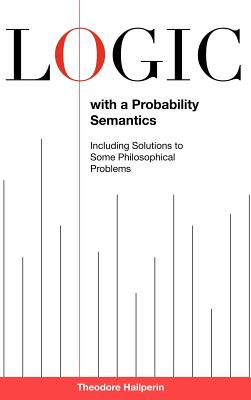
Logic with a Probability Semantics
Book Details
Format
Hardback
ISBN-10
1611460107
ISBN-13
9781611460100
Publisher
Associated University Presses
Imprint
Lehigh University Press
Country of Manufacture
GB
Country of Publication
GB
Publication Date
Dec 16th, 2010
Print length
126 Pages
Weight
342 grams
Dimensions
23.90 x 16.20 x 1.40 cms
Product Classification:
Mathematical logicProbability & statisticsProbability and statistics
KSh 13,550.00
Currently unavailable
0 in stock
Delivery Location
Delivery fee: Select location
Secure
Quality
Fast
The book extends the development of probability logic—a logic using probability, not verity (true, false) as the basic semantic notion. The basic connectives "not," "and," and "or" are described in depth to include quantified formulas. Also discussed is the notion of the suppositional and resolution of the paradox of confirmation.
The book extends the development of probability logic—a logic using probability, not verity (true, false) as the basic semantic notion. The basic connectives "not," "and," and "or" are described in depth to include quantified formulas. Also discussed is the notion of the suppositional and resolution of the paradox of confirmation.
Get Logic with a Probability Semantics by Theodore Hailperin at the best price and quality guaranteed only at Werezi Africa's largest book ecommerce store. The book was published by Associated University Presses and it has 126 pages.
Customers Who Bought This Also Bought
Elements of 8-Category Theory
KSh 13,300.00

Fuzzy Set Theory—and Its Applications
KSh 47,350.00
Lectures in Logic and Set Theory
KSh 9,550.00

Complex Dynamical Systems
KSh 19,250.00
Distributed Networks
KSh 16,400.00
Suguru Puzzle Book
KSh 0.00

The Baseball Mysteries
KSh 5,450.00

Information Security and Optimization
KSh 22,500.00

Problem Solving In Operation Management
KSh 14,400.00

Belief Change
KSh 32,400.00

Neutrosophic Computing and Vague Data Analysis
KSh 22,500.00

Introduction to Modern Cryptography, Revised Third Edition
KSh 9,350.00
