
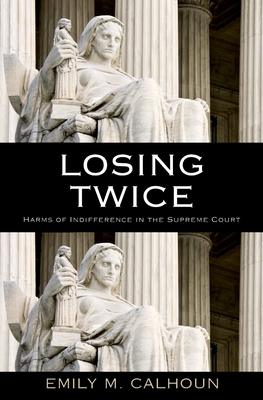
Losing Twice : Harms of Indifference in the Supreme Court
Book Details
Format
Hardback
ISBN-10
0195399749
ISBN-13
9780195399745
Publisher
Oxford University Press Inc
Imprint
Oxford University Press Inc
Country of Manufacture
GB
Country of Publication
GB
Publication Date
May 12th, 2011
Print length
192 Pages
Weight
386 grams
Dimensions
16.30 x 23.90 x 2.50 cms
Product Classification:
Human rightsCourts & procedureConstitutional & administrative law
KSh 8,600.00
Temporarily out of stock, due soon
0 in stock
Delivery Location
Delivery fee: Select location
Secure
Quality
Fast
In Losing Twice, Emily Calhoun draws upon conflict resolution theory, political theory, and Habermasian discourse theory to argue that in such cases, the Court must work harder to avoid inflicting unnecessary harm on Constitutional losers. But for this to happen, Calhoun contends, the role of judges needs to be reconceptualized. She contends that the Court should not perceive itself simply as an adversarial forum, but also as a ''transactional'' one, where losers are not simply losers but participants in a process capable of addressing and ameliorating the effects that come with loss.
Constitutional ''losers'' represent a thorny and longstanding problem in American constitutional law. Given our adversarial system, the way that rights cases are decided means that regardless of whether a losing side has committed any actions that cause harm to others, they typically suffer unnecessary harm as a consequence of decisions. In areas such as affirmative action and gay rights, the losers are essentially punished for losing despite neither intending nor causing injury. In Losing Twice, Emily Calhoun draws upon conflict resolution theory, political theory, and Habermasian discourse theory to argue that in such cases, the Court must work harder to avoid inflicting unnecessary harm on Constitutional losers. But for this to happen, Calhoun contends, the role of judges needs to be reconceptualized. She contends that the Court should not perceive itself simply as an adversarial forum, but also as a ''transactional'' one, where losers are not simply losers but participants in a process capable of addressing and ameliorating the effects that come with loss. Filled with lucid discussions of well known cases, Losing Twice offers an intellectually powerful argument for transforming the decision-making process in Constitutional rights disputes.
Get Losing Twice by Emily M. Calhoun at the best price and quality guaranteed only at Werezi Africa's largest book ecommerce store. The book was published by Oxford University Press Inc and it has 192 pages.
Customers Who Bought This Also Bought
Development as Freedom
KSh 2,900.00

Autobiography of Malcolm X
KSh 2,350.00
Cobalt Red
KSh 2,900.00

Long Walk To Freedom
KSh 2,850.00

Pedagogy of the Oppressed
KSh 2,000.00
The Color of Law – A Forgotten History of How Our Government Segregated America
KSh 2,550.00

Patriot
KSh 2,000.00
No Name in the Street
KSh 2,000.00

Recognising the Stranger
KSh 1,800.00
Winnie & Nelson
KSh 2,350.00
Moving the Centre
KSh 4,850.00

What You Have Heard Is True
KSh 2,350.00
