
Search

Categories

    • categories-img Jacket, Women
    • categories-img Woolend Jacket
    • categories-img Western denim
    • categories-img Mini Dresss
    • categories-img Jacket, Women
    • categories-img Woolend Jacket
    • categories-img Western denim
    • categories-img Mini Dresss
    • categories-img Jacket, Women
    • categories-img Woolend Jacket
    • categories-img Western denim
    • categories-img Mini Dresss
    • categories-img Jacket, Women
    • categories-img Woolend Jacket
    • categories-img Western denim
    • categories-img Mini Dresss
    • categories-img Jacket, Women
    • categories-img Woolend Jacket
    • categories-img Western denim
    • categories-img Mini Dresss

Filter By Price

$
-
$

Dietary Needs

Top Rated Product

product-img product-img

Modern Chair

$165.00
product-img product-img

Plastic Chair

$165.00
product-img product-img

Design Rooms

$165.00

Brands

  • Wooden
  • Chair
  • Modern
  • Fabric
  • Shoulder
  • Winter
  • Accessories
  • Dress

Welcome and thank you for visiting us. For any query call us on 0799 626 359 or Email [email protected]

Offcanvas Menu Open

Shopping Cart

Africa largest book store

Sub Total:

Search for any Title

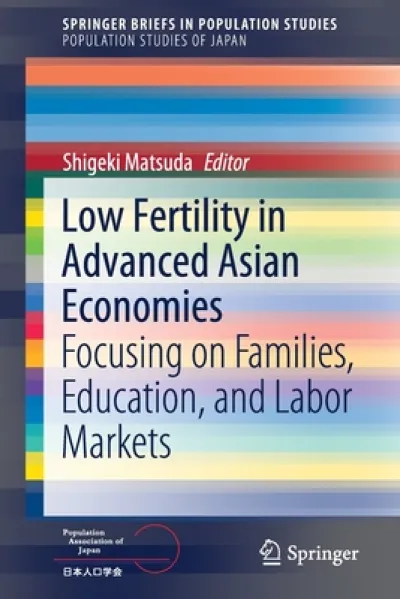
Low Fertility in Advanced Asian Economies : Focusing on Families, Education, and Labor Markets - 2020 ed.

By: (Edited by) Shigeki Matsuda

Werezi Extended Catalogue
Delivery in 28 days

Ksh 9,900.00

Format: Paperback / Softback

ISBN-10: 9811507090

ISBN-13: 9789811507090

Edition: 2020 ed.

Series: Population Studies of Japan

Publisher: Springer Verlag, Singapore

Imprint: Springer Verlag, Singapore

Country of Manufacture: GB

Country of Publication: GB

Publication Date: Jan 28th, 2020

Print length: 84 Pages

Choose your Location

Shipping & Delivery

Door Delivery

Delivery fee

Delivery in 28 days

  • Description

  • Reviews

This book focuses on the links between family, education, and employment systems in the Asian developed economies, proposing that these three systems and their interrelations are powerful factors causing the low fertility in Asia. The phenomenon of low fertility has been widely observed in developed countries, and the birthrate in Asian countries is among the lowest in the world. Although these countries have implemented measures to counter the falling birthrate, the expected effect has not yet been achieved. Moreover, Asia has seen a rapid decrease in the number of marriages. To promote effective countermeasures, it is necessary to clarify the factors influencing the low birthrate and decline in the number of marriages. Based on a statistical analysis of survey results mainly from Japan, South Korea, and Singapore, this book discusses several important points. First, because the family system is strong, cohabitation and children born to single mothers arenot socially accepted. Further, mothers play a strong role in fulfilling expectations for children’s education. Second, the popularization of higher education and intense academic competition, which have been a driving force for rapid economic growth, have led to many parents opting to have fewer children, as the cost of education is high. Lastly, wage disparity is large and employment stability is a matter of concern. These factors increase competition within education and, in turn, make it difficult for the young generation to choose marriage. Within the employment environment, balancing work and family life is problematical, especially for women.

This book focuses on the links between family, education, and employment systems in the Asian developed economies, proposing that these three systems and their interrelations are powerful factors causing the low fertility in Asia.

The phenomenon of low fertility has been widely observed in developed countries, and the birthrate in Asian countries is among the lowest in the world. Although these countries have implemented measures to counter the falling birthrate, the expected effect has not yet been achieved. Moreover, Asia has seen a rapid decrease in the number of marriages. To promote effective countermeasures, it is necessary to clarify the factors influencing the low birthrate and decline in the number of marriages.

Based on a statistical analysis of survey results mainly from Japan, South Korea, and Singapore, this book discusses several important points. First, because the family system is strong, cohabitation and children born to single mothers are not socially accepted. Further, mothers play a strong role in fulfilling expectations for children''s education. Second, the popularization of higher education and intense academic competition, which have been a driving force for rapid economic growth, have led to many parents opting to have fewer children, as the cost of education is high. Lastly, wage disparity is large and employment stability is a matter of concern. These factors increase competition within education and, in turn, make it difficult for the young generation to choose marriage. Within the employment environment, balancing work and family life is problematical, especially for women.


Get Low Fertility in Advanced Asian Economies by at the best price and quality guranteed only at Werezi Africa largest book ecommerce store. The book was published by Springer Verlag, Singapore and it has pages. Enjoy Shopping Best Offers & Deals on books Online from Werezi - Receive at your doorstep - Fast Delivery - Secure mode of Payment

Customer Reviews

Based on 0 reviews

Mind, Body, & Spirit
