
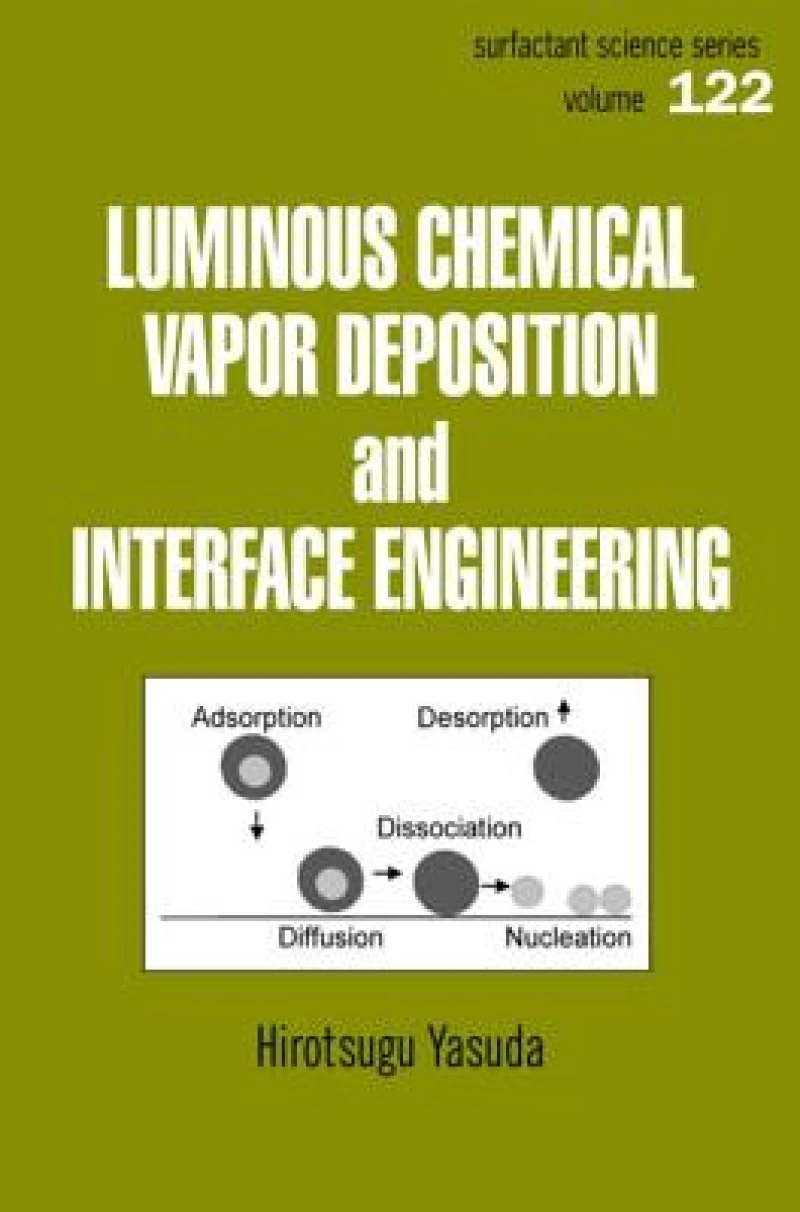
Luminous Chemical Vapor Deposition and Interface Engineering
Book Details
Format
Hardback or Cased Book
Book Series
Surfactant Science
ISBN-10
0824757882
ISBN-13
9780824757885
Publisher
Taylor & Francis Inc
Imprint
CRC Press Inc
Country of Manufacture
GB
Country of Publication
GB
Publication Date
Nov 30th, 2004
Print length
840 Pages
Weight
1,610 grams
Product Classification:
Physical chemistryChemical engineeringMaterials science
Ksh 49,500.00
Werezi Extended Catalogue
0 in stock
Delivery Location
Delivery fee: Select location
Secure
Quality
Fast
Covers the development and utilization of LCVD procedures in industrial scale applications. This book describes the difference between glow discharge of an inert gas and that of an organic vapor. It explores the various ways of practicing Luminous Vapor Disposition and Treatment depending on the type and nature of substrates.
Providing in-depth coverage of the technologies and various approaches, Luminous Chemical Vapor Deposition and Interface Engineering showcases the development and utilization of LCVD procedures in industrial scale applications. It offers a wide range of examples, case studies, and recommendations for clear understanding of this innovative science.
The book comprises four parts. Part 1 describes the fundamental difference between glow discharge of an inert gas and that of an organic vapor, from which the concepts of Luminous Gas Phase derive. Part 2 explores the various ways of practicing Luminous Vapor Disposition and Treatment depending on the type and nature of substrates. Part 3 covers some very important aspects of surface and interface that could not have been seen clearly without results obtained by application of LCVD. Part 4 offers some examples of interface engineering that show very unique aspects of LCVD interface engineering in composite materials, biomaterial surface and corrosion protection by the environmentally benign process.
Timely and up-to-date, the book provides broad coverage of the complex relationships involved in the interface between a gas/solid, liquid/solid, and a solid/solid. The author presents a new perspective on low-pressure plasma and describes key aspects of the surface and interface that could not be shown without the results obtained by LCVD technologies.
Features
Provides broad coverage of complex relationships involved in interface between a gas/solid, a liquid/solid, and a solid/solid
Addresses the importance of the initial step of creating electrical glow discharge
Describes the principles of creating chemically reactive species and their growth in the luminous gas phase
Focuses on the nature of surface-state of solid and on the creation of imperturbable surface-state by the contacting phase or environment, which is vitally important in creating biocompatible surface, providing super corrosion protection of metals by environmentally benign processes, etc.
Offers examples on how to use LCVD in the interface engineering process
Presents a new view on low-pressure (low-temperature) plasma and emphasizes the importance of luminous gas phase and chemical reactions that occur in the phase
About the author:
Dr. Yasuda is one of the pioneers who explored low-pressure plasma for surface modification of materials and deposition of nano films as barrier and perm-selective membranes in the late 1960s. He obtained his PhD in physical and polymer chemistry working on transport properties of gases and vapors in polymers at State University of New York, College of Environmental Science and Forestry at Syracuse, NY. He has over 300 publications in refereed journals and books, and is currently a Professor Emeritus of Chemical Engineering, and Director, Center for Surface Science & Plasma Technology, University of Missouri-Columbia, and is actively engaged in research on the subjects covered by this book.
The book comprises four parts. Part 1 describes the fundamental difference between glow discharge of an inert gas and that of an organic vapor, from which the concepts of Luminous Gas Phase derive. Part 2 explores the various ways of practicing Luminous Vapor Disposition and Treatment depending on the type and nature of substrates. Part 3 covers some very important aspects of surface and interface that could not have been seen clearly without results obtained by application of LCVD. Part 4 offers some examples of interface engineering that show very unique aspects of LCVD interface engineering in composite materials, biomaterial surface and corrosion protection by the environmentally benign process.
Timely and up-to-date, the book provides broad coverage of the complex relationships involved in the interface between a gas/solid, liquid/solid, and a solid/solid. The author presents a new perspective on low-pressure plasma and describes key aspects of the surface and interface that could not be shown without the results obtained by LCVD technologies.
Features
About the author:
Dr. Yasuda is one of the pioneers who explored low-pressure plasma for surface modification of materials and deposition of nano films as barrier and perm-selective membranes in the late 1960s. He obtained his PhD in physical and polymer chemistry working on transport properties of gases and vapors in polymers at State University of New York, College of Environmental Science and Forestry at Syracuse, NY. He has over 300 publications in refereed journals and books, and is currently a Professor Emeritus of Chemical Engineering, and Director, Center for Surface Science & Plasma Technology, University of Missouri-Columbia, and is actively engaged in research on the subjects covered by this book.
Get Luminous Chemical Vapor Deposition and Interface Engineering by at the best price and quality guaranteed only at Werezi Africa's largest book ecommerce store. The book was published by Taylor & Francis Inc and it has pages.

