
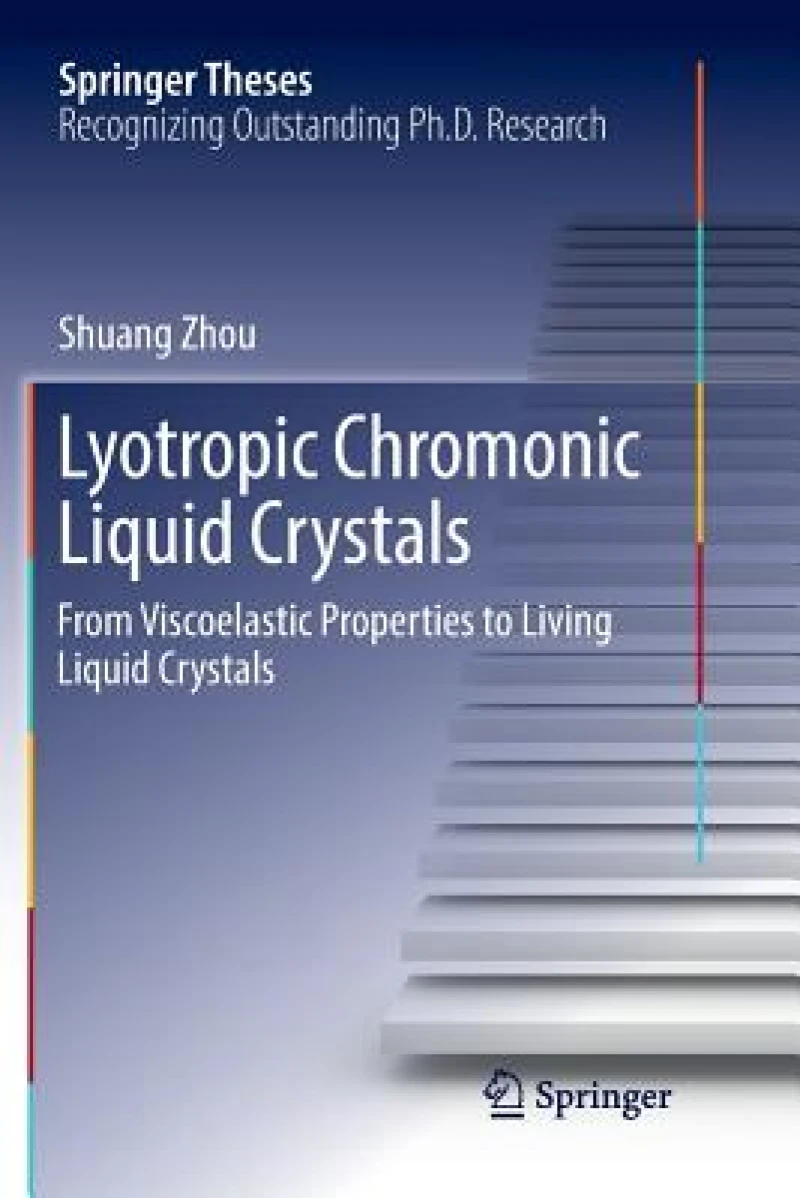
Lyotropic Chromonic Liquid Crystals : From Viscoelastic Properties to Living Liquid Crystals
Softcover reprint of the original 1st ed. 2017
by
Shuang Zhou
Book Details
Format
Paperback / Softback
Book Series
Springer Theses
ISBN-10
3319849905
ISBN-13
9783319849904
Edition
Softcover reprint of the original 1st ed. 2017
Publisher
Springer International Publishing AG
Imprint
Springer International Publishing AG
Country of Manufacture
GB
Country of Publication
GB
Publication Date
Jul 13th, 2018
Print length
95 Pages
Ksh 16,200.00
Werezi Extended Catalogue
0 in stock
Delivery Location
Delivery fee: Select location
Secure
Quality
Fast
Anisotropic interactions between LCLCs and bacteria lead to fascinating phenomena such as the deformation of LCLCs with a characteristic wavelength determined by the elasticity of the LCLCs and the activity of the bacteria, orientationally controlled trajectories of bacteria and visualization of 24 nm flagella motion.
This thesis describes lyotropic chromonic liquid crystals (LCLCs) with exotic elastic and viscous properties. The first part of the thesis presents a thorough analysis of the elastic and viscous properties of LCLCs as functions of concentration, temperature and ionic contents, while the second part explores an active nematic system: living liquid crystals, which represent a combination of LCLC and living bacteria.
LCLCs are an emerging class of liquid crystals that have shown profound connections to biological systems in two aspects. First, the assembly process of the chromonic aggregates is essentially the same as DNA oligomers and other super-molecular assemblies of biological origin. LCLCs thus provide an excellent model system for studying physical properties such as the elasticity and viscosity of these supramolecular assemblies. Second, LCLCs are biocompatible, thus serving as a unique anisotropic matrix to interface with living systems such as bacteria.
This thesis deepens our understanding of both aspects. The noncovalent nature of chromonic aggregation produces the unique viscoelasticity to be found in LCLCs, which differs dramatically from that of traditional LCs. Anisotropic interactions between LCLCs and bacteria lead to fascinating phenomena such as the deformation of LCLCs with a characteristic wavelength determined by the elasticity of the LCLCs and the activity of the bacteria, orientationally controlled trajectories of bacteria and visualization of 24 nm flagella motion.
Get Lyotropic Chromonic Liquid Crystals by at the best price and quality guaranteed only at Werezi Africa's largest book ecommerce store. The book was published by Springer International Publishing AG and it has pages.

