

Machine Learning for Microbiome Statistics
Book Details
Format
Hardback
Book Series
Chapman & Hall/CRC Biostatistics Series
ISBN-10
1041005245
ISBN-13
9781041005247
Publisher
Taylor & Francis Ltd
Imprint
CRC Press
Country of Manufacture
GB
Country of Publication
GB
Publication Date
Feb 25th, 2026
Print length
656 Pages
Weight
1,410 grams
Product Classification:
Probability & statisticsProbability and statisticsMachine learning
KSh 30,950.00
Currently unavailable
0 in stock
Delivery Location
Delivery fee: Select location
Secure
Quality
Fast
This unique book aims to address the challenges of machine learning statistics, emphasize the importance of performance valuation by appropriate metrics and independent data, and describe several important concepts of machine learning statistics, such as feature engineering and overfitting.
Machine learning fundamentally learns from the past experiences (seen data) to make predictions about future (unseen data). Predictions in nature are often uncertain. Microbiome data have unique characteristics, including high-dimensionality, over-dispersion, sparsity and zero-inflation, and heterogeneity. Thus, machine learning involving microbiome data for predicting the outcome of phenotypes is even more uncertain than learning those data from other fields. Machine Learning for Microbiome Statistics poses many challenges for evaluating the prediction performance using appropriate metrics and independent data validation. This unique book aims to address the challenges of machine learning statistics, emphasize the importance of performance valuation by appropriate metrics and independent data, and describe several important concepts of machine learning statistics, such as feature engineering and overfitting. It comprehensively reviews commonly used and newly developed machine learning models for microbiome research. Specifically, this book provides the step-by-step procedures to perform machine learning of microbiome data, including feature engineering, algorithm selection and optimization, performance evaluation and model testing. It comments the benefits and limitations of using machine learning for microbiome statistics and remarks on the advantages and disadvantages of each machine learning algorithm. It will be an excellent reference book for students and academics in the field. Presents a thorough overview of machine learning algorithms for microbiome statistics. Performs step-by-step procedures to perform machine learning of microbiome data, using important supervised learning algorithms, including classical, ensemble learning and tree-based models. Describes important concepts of machine learning, including bias and variance tradeoff, accuracy and precision, overfitting and underfitting, model complexity and interpretability, and feature engineering. Investigates and applies various cross-validation techniques step-by-step. Introduces confusion matrix and its derived measures. Comprehensively describes the properties of F1, Matthews’ correlation coefficient (MCC), area under the receiver operating characteristic curve (AUC-ROC), and area under the precision-recall curve (AUC-PR), as well as discusses their advantages and disadvantages when using them for microbiome data. Offers all related R codes and the datasets from the authors’ first-hand microbiome research and publicly available data.
Get Machine Learning for Microbiome Statistics by Jun Sun, Yinglin Xia at the best price and quality guaranteed only at Werezi Africa's largest book ecommerce store. The book was published by Taylor & Francis Ltd and it has 656 pages.
Customers Who Bought This Also Bought

How to Lie with Statistics
KSh 2,350.00

Pearson Edexcel International A Level Mathematics Statistics 1 Student Book
KSh 5,900.00
White Noise Distribution Theory
KSh 9,750.00

Pearson Edexcel International A Level Mathematics Statistics 3 Student Book
KSh 5,700.00

Pearson Edexcel International A Level Mathematics Statistics 2 Student Book
KSh 5,700.00
Caie Al Maths - Prob 1
KSh 4,500.00
Scouting and Scoring – How We Know What We Know about Baseball
KSh 3,050.00
Caie Al Maths - Prob 2
KSh 4,450.00

Modeling Cancer Progression and the Effects of Treatment
KSh 21,950.00

Introduction to Data Science
KSh 9,900.00

Stochastic Differential Equations
KSh 13,150.00

The Evidential Foundations of Probalistic Reasoning
KSh 6,850.00
More by Jun Sun, Yinglin Xia

Electromagnetic Compatibility
KSh 13,500.00

Statistical Analysis of Microbiome Data with R
KSh 27,000.00

Microbiome Statistics, Two-Volume Set
KSh 44,100.00
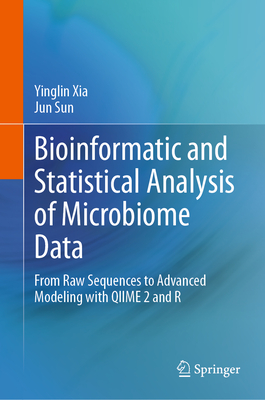
Bioinformatic and Statistical Analysis of Microbiome Data
KSh 32,400.00
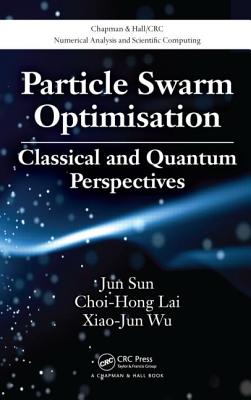
Particle Swarm Optimisation
KSh 37,800.00
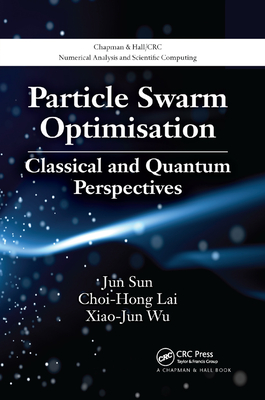
Particle Swarm Optimisation
KSh 12,800.00
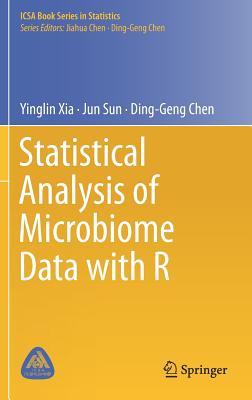
Statistical Analysis of Microbiome Data with R
KSh 27,000.00

Applied Microbiome Data Analysis
KSh 30,950.00

Bioinformatic and Statistical Analysis of Microbiome Data
KSh 32,400.00

Electromagnetic Compatibility
KSh 9,900.00
More in This Genre
How to Lie with Statistics
KSh 2,350.00
Pearson Edexcel International A Level Mathematics Statistics 1 Student Book
KSh 5,900.00
White Noise Distribution Theory
KSh 9,750.00
Pearson Edexcel International A Level Mathematics Statistics 3 Student Book
KSh 5,700.00
Pearson Edexcel International A Level Mathematics Statistics 2 Student Book
KSh 5,700.00
Caie Al Maths - Prob 1
KSh 4,500.00
