
Cart 0
Machine Learning in Social Networks
Click to zoom

Share this book

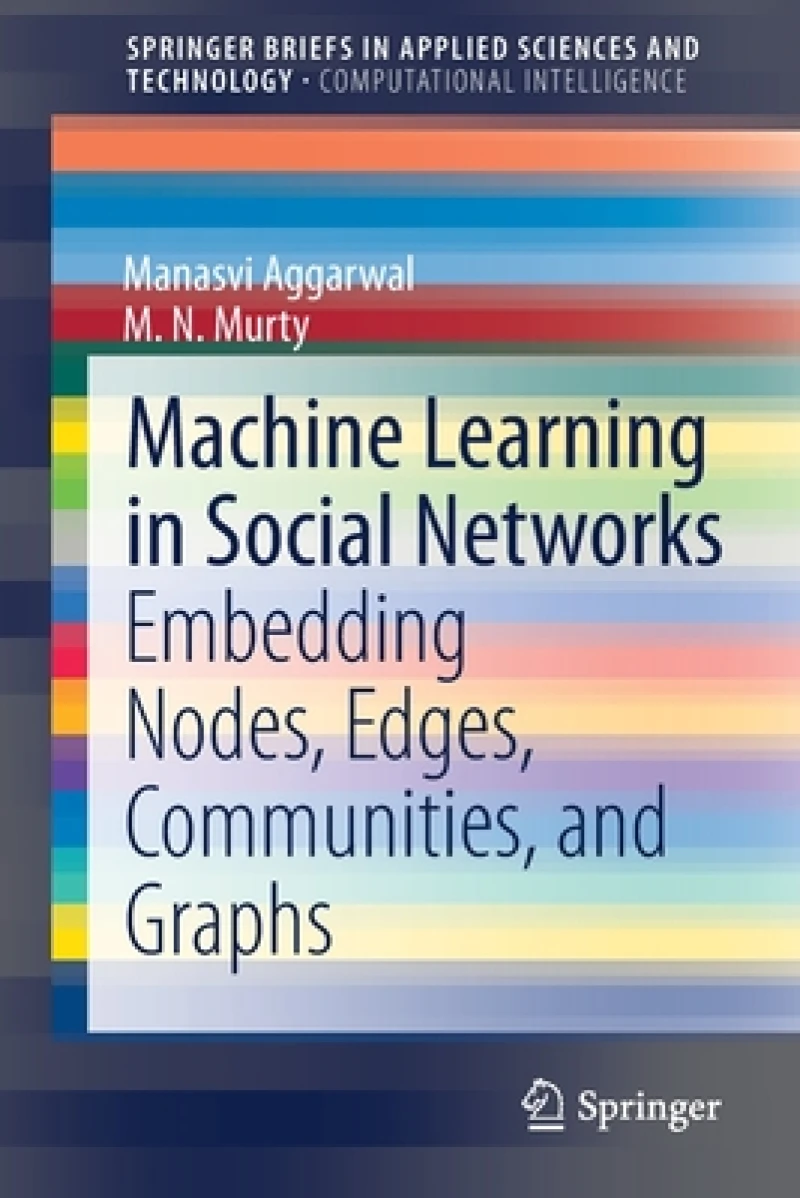
Machine Learning in Social Networks : Embedding Nodes, Edges, Communities, and Graphs

1st ed. 2021

Book Details

Format Paperback / Softback
ISBN-10 9813340215
ISBN-13 9789813340213
Edition 1st ed. 2021
Publisher Springer Verlag, Singapore
Imprint Springer Verlag, Singapore
Country of Manufacture GB
Country of Publication GB
Publication Date Nov 26th, 2020
Print length 112 Pages
Product Classification: Mathematical modellingMachine learning
Ksh 9,900.00
Werezi Extended Catalogue Delivery in 14 days

Delivery Location

Delivery fee: Select location

Delivery in 14 days

Secure
Quality
Fast
This book deals with network representation learning. It deals with embedding nodes, edges, subgraphs and graphs. There is a growing interest in understanding complex systems in different domains including health, education, agriculture and transportation. Such complex systems are analyzed by modeling, using networks that are aptly called complex networks. Networks are becoming ubiquitous as they can represent many real-world relational data, for instance, information networks, molecular structures, telecommunication networks and protein–protein interaction networks. Analysis of these networks provides advantages in many fields such as recommendation (recommending friends in a social network), biological field (deducing connections between proteins for treating new diseases) and community detection (grouping users of a social network according to their interests) by leveraging the latent information of networks. An active and important area ofcurrent interest is to come out with algorithms that learn features by embedding nodes or (sub)graphs into a vector space. These tasks come under the broad umbrella of representation learning. A representation learning model learns a mapping function that transforms the graphs' structure information to a low-/high-dimension vector space maintaining all the relevant properties. 

This book deals with network representation learning. It deals with embedding nodes, edges, subgraphs and graphs. There is a growing interest in understanding complex systems in different domains including health, education, agriculture and transportation. Such complex systems are analyzed by modeling, using networks that are aptly called complex networks. Networks are becoming ubiquitous as they can represent many real-world relational data, for instance, information networks, molecular structures, telecommunication networks and protein-protein interaction networks. Analysis of these networks provides advantages in many fields such as recommendation (recommending friends in a social network), biological field (deducing connections between proteins for treating new diseases) and community detection (grouping users of a social network according to their interests) by leveraging the latent information of networks. An active and important area of current interest is to come out with algorithms that learn features by embedding nodes or (sub)graphs into a vector space. These tasks come under the broad umbrella of representation learning. A representation learning model learns a mapping function that transforms the graphs'' structure information to a low-/high-dimension vector space maintaining all the relevant properties. 


Get Machine Learning in Social Networks by at the best price and quality guaranteed only at Werezi Africa's largest book ecommerce store. The book was published by Springer Verlag, Singapore and it has pages.


Mind, Body, & Spirit

Price

Ksh 9,900.00

Shopping Cart

Africa largest book store

Sub Total:
Ebooks

Digital Library
Coming Soon

Our digital collection is currently being curated to ensure the best possible reading experience on Werezi. We'll be launching our Ebooks platform shortly.