
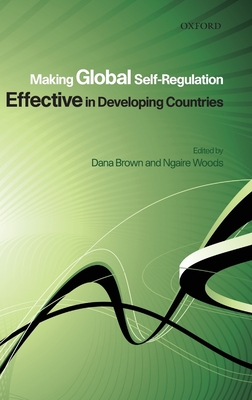
Making Global Self-Regulation Effective in Developing Countries
Book Details
Format
Hardback
ISBN-10
0199234639
ISBN-13
9780199234639
Publisher
Oxford University Press
Imprint
Oxford University Press
Country of Manufacture
GB
Country of Publication
GB
Publication Date
Oct 4th, 2007
Print length
282 Pages
Weight
585 grams
Dimensions
24.10 x 16.20 x 2.20 cms
Product Classification:
Development studiesPolitical economy
KSh 11,600.00
Temporarily out of stock, due soon
0 in stock
Delivery Location
Delivery fee: Select location
Secure
Quality
Fast
As companies 'go global' they increasingly use factories and facilities spread across the world. But who regulates their activities in far flung corners of the world economy? The chapters in this volume evaluate the effectiveness of self-regulation compared to other forms of global regulation.
As companies ''go global'' they increasingly use factories and facilities spread across the world. But who regulates their activities in far flung corners of the world economy? In many sectors such as textiles and apparel, chemicals, and forestry, the answer is that companies regulate their own behaviour through codes and standards which they agree among themselves. The recent growth in corporate self-regulation of labour, environmental and financial practices has attracted the attention of scholars who have detailed the number and content of self-regulatory efforts in various sectors. Missing so far, however, has been an analysis of the effectiveness and impact of self-regulation. Does self-regulation actually work and under what conditions is it most likely to be effective? The answer to this question is particularly important for developing countries where corporate self-regulation is often seen as substitute for weak governance structures. The chapters in this volume evaluate the effectiveness of self-regulation compared to other forms of global regulation. Across sectors and states, corporate self-regulation works best when those who are regulated have a voice in deciding the content of codes and standards and when some mechanism of compliance exists at the level of the state. Unfortunately, opportunities for voice and state capacity for regulation are often lacking in developing countries. Given this, the book suggests some minimal forms of government action and participation by global actors that can make global corporate self-regulation more effective in bettering conditions in the developing world.
Get Making Global Self-Regulation Effective in Developing Countries by Dana L. Brown at the best price and quality guaranteed only at Werezi Africa's largest book ecommerce store. The book was published by Oxford University Press and it has 282 pages.
Customers Who Bought This Also Bought

How Africa Works
KSh 3,050.00

Development as Freedom
KSh 2,900.00

How Africa Works
KSh 4,500.00

Anti-Politics Machine
KSh 3,750.00

We Are Not Able to Live in the Sky
KSh 3,400.00

Apostles of Development
KSh 5,600.00

The Bottom Billion
KSh 2,500.00

Indigenous Knowledge Inquiries
KSh 6,600.00

Why Africa is poor
KSh 2,350.00

Historical Dictionary of Aid and Development Organizations
KSh 12,050.00

Contemporary Latin American Architecture
KSh 7,900.00
The Poverty of Growth
KSh 2,900.00
