
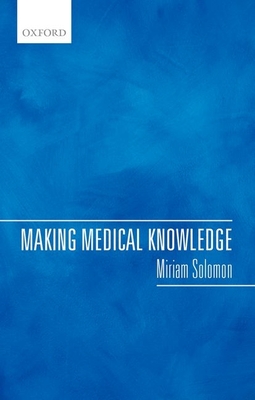
Making Medical Knowledge
Book Details
Format
Hardback
ISBN-10
0198732619
ISBN-13
9780198732617
Publisher
Oxford University Press
Imprint
Oxford University Press
Country of Manufacture
GB
Country of Publication
GB
Publication Date
Apr 2nd, 2015
Print length
278 Pages
Weight
470 grams
Dimensions
22.60 x 14.70 x 2.50 cms
Product Classification:
PhilosophyPhilosophy: epistemology & theory of knowledgeHistory of medicinePhilosophy of science
KSh 17,800.00
Temporarily out of stock, due soon
0 in stock
Delivery Location
Delivery fee: Select location
Secure
Quality
Fast
How is medical knowledge made? There have been radical changes in recent decades, through new methods such as consensus conferences, evidence-based medicine, translational medicine, and narrative medicine. Miriam Solomon explores their origins, aims, and epistemic strengths and weaknesses; and she offers a pluralistic approach for the future.
How is medical knowledge made? New methods for research and clinical care have reshaped the practices of medical knowledge production over the last forty years. Consensus conferences, evidence-based medicine, translational medicine, and narrative medicine are among the most prominent new methods. Making Medical Knowledge explores their origins and aims, their epistemic strengths, and their epistemic weaknesses. Miriam Solomon argues that the familiar dichotomy between the art and the science of medicine is not adequate for understanding this plurality of methods. The book begins by tracing the development of medical consensus conferences, from their beginning at the United States'' National Institutes of Health in 1977, to their widespread adoption in national and international contexts. It discusses consensus conferences as social epistemic institutions designed to embody democracy and achieve objectivity. Evidence-based medicine, which developed next, ranks expert consensus at the bottom of the evidence hierarchy, thus challenging the authority of consensus conferences. Evidence-based medicine has transformed both medical research and clinical medicine in many positive ways, but it has also been accused of creating an intellectual hegemony that has marginalized crucial stages of scientific research, particularly scientific discovery. Translational medicine is understood as a response to the shortfalls of both consensus conferences and evidence-based medicine. Narrative medicine is the most prominent recent development in the medical humanities. Its central claim is that attention to narrative is essential for patient care. Solomon argues that the differences between narrative medicine and the other methods have been exaggerated, and offers a pluralistic account of how the all the methods interact and sometimes conflict. The result is both practical and theoretical suggestions for how to improve medical knowledge and understand medical controversies.
Get Making Medical Knowledge by Miriam Solomon at the best price and quality guaranteed only at Werezi Africa's largest book ecommerce store. The book was published by Oxford University Press and it has 278 pages.
Customers Who Bought This Also Bought
Decolonizing Language and Other Revolutionary Ideas
KSh 2,350.00
How to Read a Book
KSh 2,000.00
Decolonizing Language and Other Revolutionary Ideas
KSh 3,600.00
Creative Act
KSh 3,250.00
Groundwork for the Metaphysics of Morals
KSh 2,000.00

Things in Nature Merely
KSh 2,000.00
Meditations – The Philosophy Classic
KSh 2,150.00

Great Ideas Social Contract
KSh 1,450.00
How to Be a Leader – An Ancient Guide to Wise Leadership
KSh 2,800.00

The Daily Laws
KSh 2,350.00

Three Critiques, 3-volume Set
KSh 14,000.00

Philosophical Dictionary
KSh 2,700.00

