
Book Details
Format
Hardback or Cased Book
ISBN-10
1442212292
ISBN-13
9781442212299
Edition
Second Edition
Publisher
Bloomsbury Publishing Plc
Imprint
Rowman & Littlefield Publishers
Country of Manufacture
GB
Country of Publication
GB
Publication Date
Feb 16th, 2012
Print length
296 Pages
Weight
586 grams
Dimensions
16.20 x 23.70 x 2.50 cms
Product Classification:
Geopolitics
Ksh 21,800.00
Werezi Extended Catalogue
0 in stock
Delivery Location
Delivery fee: Select location
Secure
Quality
Fast
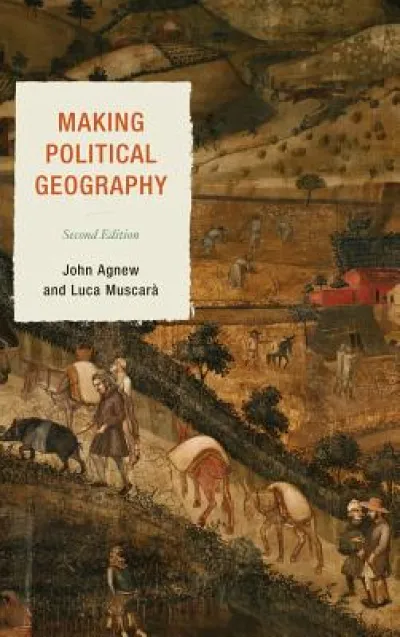
Dating from its inception in the late nineteenth century, political geography as a field has been heavily influenced by global events of the time. Thus, rather than trying to impose a single “fashionable” theory, leading geographers John Agnew and Luca Muscarà consider the underlying role of changing geopolitical context as their framework for understanding the evolution of the discipline. The authors trace the development of key thinkers and theories during three distinct periods—1875–1945, the Cold War, and the post–Cold War—emphasizing the ongoing struggle between theoretical “monism” and “pluralism,” or one path to knowledge versus many. The world has undergone dramatic shifts since the book’s first publication in 2002, and this thoroughly revised and updated second edition focuses especially on reinterpretations of the post–Cold War period. Agnew and Muscarà explore the renewed questioning of international borders, the emergence of the Middle East and displacement of Europe as the center of global geopolitics, the rise of China and other new powers, the reappearance of environmental issues, and the development of critical geopolitics. With its deeply knowledgeable and balanced history and overview of the field, this concise work will be a valuable and flexible text for all courses in political geography.
Dating from its inception in the late nineteenth century, political geography as a field has been heavily influenced by global events of the time. Thus, rather than trying to impose a single “fashionable” theory, leading geographers John Agnew and Luca Muscarà consider the underlying role of changing geopolitical context as their framework for understanding the evolution of the discipline. The authors trace the development of key thinkers and theories during three distinct periods—1875–1945, the Cold War, and the post–Cold War—emphasizing the ongoing struggle between theoretical “monism” and “pluralism,” or one path to knowledge versus many. The world has undergone dramatic shifts since the book’s first publication in 2002, and this thoroughly revised and updated second edition focuses especially on reinterpretations of the post–Cold War period. Agnew and Muscarà explore the renewed questioning of international borders, the emergence of the Middle East and displacement of Europe as the center of global geopolitics, the rise of China and other new powers, the reappearance of environmental issues, and the development of critical geopolitics. With its deeply knowledgeable and balanced history and overview of the field, this concise work will be a valuable and flexible text for all courses in political geography.
Get Making Political Geography by at the best price and quality guaranteed only at Werezi Africa's largest book ecommerce store. The book was published by Bloomsbury Publishing Plc and it has pages.

