
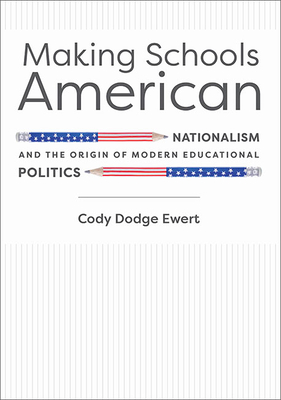
Making Schools American : Nationalism and the Origin of Modern Educational Politics
Book Details
Format
Hardback
ISBN-10
1421442795
ISBN-13
9781421442792
Publisher
Johns Hopkins University Press
Imprint
Johns Hopkins University Press
Country of Manufacture
US
Country of Publication
GB
Publication Date
Jun 14th, 2022
Print length
232 Pages
Weight
472 grams
Dimensions
16.10 x 23.50 x 2.60 cms
Product Classification:
History of the AmericasPrimary & middle schoolsPolitical science & theory
KSh 5,600.00
Currently unavailable
0 in stock
Delivery Location
Delivery fee: Select location
Secure
Quality
Fast
How school reformers in the Progressive Era—who envisioned the public school as the quintessential American institution—laid the groundwork for contemporary battles over the structure and curriculum of public schools. Around the turn of the twentieth century, a generation of school reformers began touting public education's unique capacity to unite a diverse and diffuse citizenry while curing a broad swath of social and political ills. They claimed that investing in education would equalize social and economic relations, strengthen democracy, and create high-caliber citizens equipped for the twentieth century, all while preserving the nation's sacred traditions. More than anything, they pitched the public school as a quintessentially American institution, a patriotic symbol in its own right—and the key to perfecting the American experiment. In Making Schools American, Cody Dodge Ewert makes clear that nationalism was the leading argument for schooling during the Progressive Era. Bringing together case studies of school reform crusades in New York, Utah, and Texas, he explores what was gained—and lost—as efforts to transform American schools evolved across space and time. Offering fresh insight into the development and politicization of public schooling in America, Ewert also reveals how reformers' utopian visions and lofty promises laid the groundwork for contemporary battles over the mission and methods of American public schools. Despite their divergent political visions and the unique conditions of the states, cities, and individual districts they served, school reformers wielded nationalistic rhetoric that made education a rallying point for Americans across lines of race, class, religion, and region. But ultimately, Making Schools American argues, upholding education as a potential solution to virtually every societal problem has hamstrung broader attempts at social reform while overburdening schools.
Get Making Schools American by Cody D. Ewert at the best price and quality guaranteed only at Werezi Africa's largest book ecommerce store. The book was published by Johns Hopkins University Press and it has 232 pages.
Customers Who Bought This Also Bought

Crusade for Justice – The Autobiography of Ida B. Wells, Second Edition
KSh 4,050.00

Killers of the Flower Moon
KSh 2,000.00

Warmth of Other Suns
KSh 3,050.00

Frederick Douglass
KSh 3,350.00

107 Days
KSh 4,500.00

Second Treatise of Government – Norton Library
KSh 1,600.00

Tuesdays With Morrie
KSh 2,000.00
My Bondage and My Freedom
KSh 1,600.00

Hidden Figures
KSh 2,000.00

America, América
KSh 3,650.00

Holding the Line
KSh 2,000.00

Nuclear Folly
KSh 3,050.00
