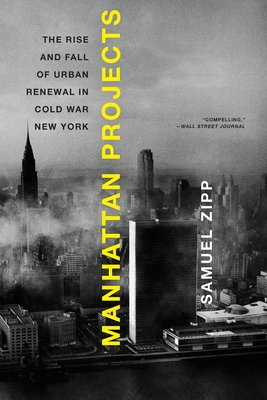
Manhattan Projects : The Rise and Fall of Urban Renewal in Cold War New York
by
Samuel Zipp
Book Details
Format
Paperback / softback
ISBN-10
0199874050
ISBN-13
9780199874057
Publisher
Oxford University Press Inc
Imprint
Oxford University Press Inc
Country of Manufacture
US
Country of Publication
GB
Publication Date
Apr 26th, 2012
Print length
496 Pages
Weight
680 grams
Dimensions
23.10 x 15.20 x 2.50 cms
Product Classification:
History of the AmericasSocial & cultural historyUrban communitiesUrban & municipal planning
KSh 8,300.00
Currently unavailable
0 in stock
Delivery Location
Delivery fee: Select location
Secure
Quality
Fast
In the two decades after World War II, New York was shaken by struggles over urban renewal. Manhattan Projects offers a fresh look at the history of those conflicts, showing how the idea of urban renewal was made and unmade as the state of the art technique for remaking cities.
In a book praised by Times Literary Supplement as "richly detailed and thoughtfully written" and by Wall Street Journal as "compelling," Samuel Zipp sheds new light on the rise and fall of urban renewal in the decades after World War II. Focusing on four iconic "Manhattan projects"--the United Nations building, Stuyvesant Town, Lincoln Center, and the great swaths of public housing in East Harlem--Zipp unearths a host of forgotten stories and characters that flesh out the conventional history of urban renewal. He shows how boosters hoped to make Manhattan the capital of modernity and a symbol of American power, but even as the builders executed their plans, a chorus of critics revealed the dark side of those visions, attacking urban renewal for perpetuating deindustrialization, racial segregation, and class division, for uprooting thousands, and for implanting a new, alienating cityscape. Urban renewal was not merely a failed planning ideal, Zipp concludes, but also a crucial phase in the transformation of New York into a world city, but one mired in urban crisis. The book won Honorable Mention for the Ellis W. Hawley Prize of the Organization of American Historians.
Get Manhattan Projects by Samuel Zipp at the best price and quality guaranteed only at Werezi Africa's largest book ecommerce store. The book was published by Oxford University Press Inc and it has 496 pages.
Customers Who Bought This Also Bought

Crusade for Justice – The Autobiography of Ida B. Wells, Second Edition
KSh 4,050.00

Killers of the Flower Moon
KSh 2,000.00
Warmth of Other Suns
KSh 3,050.00

Frederick Douglass
KSh 3,350.00
107 Days
KSh 4,500.00

Second Treatise of Government – Norton Library
KSh 1,600.00

Tuesdays With Morrie
KSh 2,000.00
My Bondage and My Freedom
KSh 1,600.00

Hidden Figures
KSh 2,000.00

America, América
KSh 3,650.00

Holding the Line
KSh 2,000.00

Nuclear Folly
KSh 3,050.00