
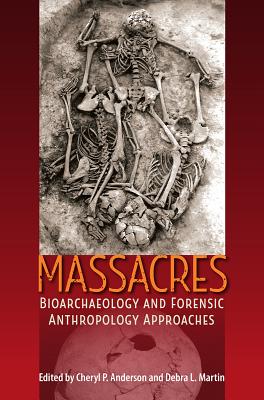
Massacres : Bioarchaeology and Forensic Anthropology Approaches
Book Details
Format
Hardback
Book Series
Bioarchaeological Interpretations of the Human Past: Local, Regional, and Global Perspectives
ISBN-10
1683400690
ISBN-13
9781683400691
Publisher
University Press of Florida
Imprint
University Press of Florida
Country of Manufacture
US
Country of Publication
GB
Publication Date
Dec 11th, 2018
Print length
272 Pages
Weight
512 grams
Dimensions
23.30 x 15.50 x 1.70 cms
Product Classification:
ArchaeologySociologyAnthropologyArchaeology
KSh 13,700.00
Temporarily out of stock, due soon
0 in stock
Delivery Location
Delivery fee: Select location
Secure
Quality
Fast
Integrates data from researchers in bioarchaeology and forensic anthropology to explain when and why group-targeted violence occurs. By analysing skeletal remains within their broader cultural and historical contexts this volume opens up important new understandings of the underlying social processes that continue to lead to these tragedies.
This volume integrates data from researchers in bioarchaeology and forensic anthropology to explain when and why group-targeted violence occurs. Massacres have plagued both ancient and modern societies, and by analyzing skeletal remains from these events within their broader cultural and historical contexts this volume opens up important new understandings of the underlying social processes that continue to lead to these tragedies.
In case studies that include Crow Creek in South Dakota, Khmer Rouge–era Cambodia, the Peruvian Andes, and northern Uganda, contributors demonstrate that massacres are a process?a nonrandom pattern of events that precede the acts of violence and continue long afterward. They also show how massacres have varying aims and are driven by culture-specific forces and logic, ranging from small events to cases of genocide. Many of these studies examine bones found in mass graves, while others focus on victims whose bodies have never been buried. Notably, the volume expands widely held definitions of massacres to include structural violence, featuring the radical argument that the large-scale death of undocumented migrants in Arizona’s Sonoran Desert should be viewed as an extended massacre.
This volume is the first to focus exclusively on massacres as a unique form of violence. Its interdisciplinary approach illuminates similarities in human behavior across time and space, provides methods for identifying killings as massacres, and helps today’s societies learn from patterns of the past.
A volume in the series Bioarchaeological Interpretations of the Human Past: Local, Regional, and Global Perspectives, edited by Clark Spencer Larsen.
In case studies that include Crow Creek in South Dakota, Khmer Rouge–era Cambodia, the Peruvian Andes, and northern Uganda, contributors demonstrate that massacres are a process?a nonrandom pattern of events that precede the acts of violence and continue long afterward. They also show how massacres have varying aims and are driven by culture-specific forces and logic, ranging from small events to cases of genocide. Many of these studies examine bones found in mass graves, while others focus on victims whose bodies have never been buried. Notably, the volume expands widely held definitions of massacres to include structural violence, featuring the radical argument that the large-scale death of undocumented migrants in Arizona’s Sonoran Desert should be viewed as an extended massacre.
This volume is the first to focus exclusively on massacres as a unique form of violence. Its interdisciplinary approach illuminates similarities in human behavior across time and space, provides methods for identifying killings as massacres, and helps today’s societies learn from patterns of the past.
A volume in the series Bioarchaeological Interpretations of the Human Past: Local, Regional, and Global Perspectives, edited by Clark Spencer Larsen.
Get Massacres by Cheryl P. Anderson at the best price and quality guaranteed only at Werezi Africa's largest book ecommerce store. The book was published by University Press of Florida and it has 272 pages.
Customers Who Bought This Also Bought
Servus
KSh 4,500.00

Memoirs of the Marquis of Torcy, Secretary of State to Lewis XIV. Containing the history of the negotiations from the Treaty of Ryswic to the Peace of Utrecht. Translated from the French. ... Volume 1 of 2
KSh 4,050.00

Memoirs of the Marquis of Torcy, Secretary of State to Lewis XIV. Containing the history of the negotiations from the Treaty of Ryswic to the Peace of Utrecht. Translated from the French. ... Volume 2 of 2
KSh 3,750.00
The Biggest Prison on Earth
KSh 2,350.00
The Stated Motivations for the Early Islamic Expansion (622–641)
KSh 16,250.00
Introducing Anthropology – What Makes Us Human?
KSh 5,250.00
Rousseau: The Social Contract and Other Later Political Writings
KSh 4,500.00
The History of Kamtschatka, and the Kurilski Islands, with the Countries Adjacent; Illustrated with Maps and Cuts. Published at Petersbourg in the Russian Language, ... and Translated Into English by James Grieve, M.D.
KSh 3,650.00

The Persians – Lost Civilizations
KSh 2,700.00

Edward I and Wales, 1254-1307
KSh 4,500.00

Plantagenet Princes
KSh 2,350.00
St. Catherines
KSh 3,700.00
More in This Genre
Servus
KSh 4,500.00
Memoirs of the Marquis of Torcy, Secretary of State to Lewis XIV. Containing the history of the negotiations from the Treaty of Ryswic to the Peace of Utrecht. Translated from the French. ... Volume 1 of 2
KSh 4,050.00
Memoirs of the Marquis of Torcy, Secretary of State to Lewis XIV. Containing the history of the negotiations from the Treaty of Ryswic to the Peace of Utrecht. Translated from the French. ... Volume 2 of 2
KSh 3,750.00
The Biggest Prison on Earth
KSh 2,350.00
The Stated Motivations for the Early Islamic Expansion (622–641)
KSh 16,250.00
Introducing Anthropology – What Makes Us Human?
KSh 5,250.00
