
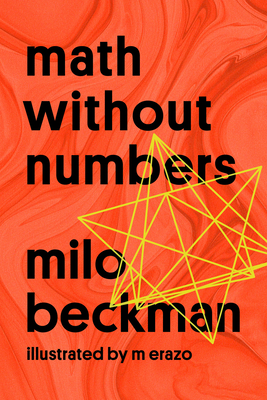
Math Without Numbers
Book Details
Format
Paperback / softback
ISBN-10
1524745561
ISBN-13
9781524745561
Publisher
Not Stated
Country of Manufacture
GB
Country of Publication
GB
Publication Date
Jan 1st, 1900
Weight
208 grams
Dimensions
13.80 x 20.90 x 1.40 cms
KSh 3,400.00
Temporarily out of stock, due soon
0 in stock
Delivery Location
Delivery fee: Select location
Secure
Quality
Fast
An illustrated tour of the structures and patterns we call "math"
The only numbers in this book are the page numbers.
Math Without Numbers is a vivid, conversational, and wholly original guide to the three main branches of abstract math—topology, analysis, and algebra—which turn out to be surprisingly easy to grasp. This book upends the conventional approach to math, inviting you to think creatively about shape and dimension, the infinite and infinitesimal, symmetries, proofs, and how these concepts all fit together. What awaits readers is a freewheeling tour of the inimitable joys and unsolved mysteries of this curiously powerful subject.
Like the classic math allegory Flatland, first published over a century ago, or Douglas Hofstadter''s Godel, Escher, Bach forty years ago, there has never been a math book quite like Math Without Numbers. So many popularizations of math have dwelt on numbers like pi or zero or infinity. This book goes well beyond to questions such as: How many shapes are there? Is anything bigger than infinity? And is math even true? Milo Beckman shows why math is mostly just pattern recognition and how it keeps on surprising us with unexpected, useful connections to the real world.
The ambitions of this book take a special kind of author. An inventive, original thinker pursuing his calling with jubilant passion. A prodigy. Milo Beckman completed the graduate-level course sequence in mathematics at age sixteen, when he was a sophomore at Harvard; while writing this book, he was studying the philosophical foundations of physics at Columbia under Brian Greene, among others.
The only numbers in this book are the page numbers.
Math Without Numbers is a vivid, conversational, and wholly original guide to the three main branches of abstract math—topology, analysis, and algebra—which turn out to be surprisingly easy to grasp. This book upends the conventional approach to math, inviting you to think creatively about shape and dimension, the infinite and infinitesimal, symmetries, proofs, and how these concepts all fit together. What awaits readers is a freewheeling tour of the inimitable joys and unsolved mysteries of this curiously powerful subject.
Like the classic math allegory Flatland, first published over a century ago, or Douglas Hofstadter''s Godel, Escher, Bach forty years ago, there has never been a math book quite like Math Without Numbers. So many popularizations of math have dwelt on numbers like pi or zero or infinity. This book goes well beyond to questions such as: How many shapes are there? Is anything bigger than infinity? And is math even true? Milo Beckman shows why math is mostly just pattern recognition and how it keeps on surprising us with unexpected, useful connections to the real world.
The ambitions of this book take a special kind of author. An inventive, original thinker pursuing his calling with jubilant passion. A prodigy. Milo Beckman completed the graduate-level course sequence in mathematics at age sixteen, when he was a sophomore at Harvard; while writing this book, he was studying the philosophical foundations of physics at Columbia under Brian Greene, among others.
Get Math Without Numbers at the best price and quality guaranteed only at Werezi Africa's largest book ecommerce store. The book was published by Not Stated.
