
Book Details
Format
Hardback or Cased Book
Book Series
Episteme
ISBN-10
0792317653
ISBN-13
9780792317654
Edition
1992 ed.
Publisher
Kluwer Academic Publishers
Imprint
Kluwer Academic Publishers
Country of Manufacture
GB
Country of Publication
GB
Publication Date
Nov 30th, 1992
Print length
218 Pages
Weight
440 grams
Dimensions
23.90 x 16.00 x 1.80 cms
Product Classification:
AnthropologyPhilosophy of science
Ksh 25,100.00
Werezi Extended Catalogue
0 in stock
Delivery Location
Delivery fee: Select location
Secure
Quality
Fast
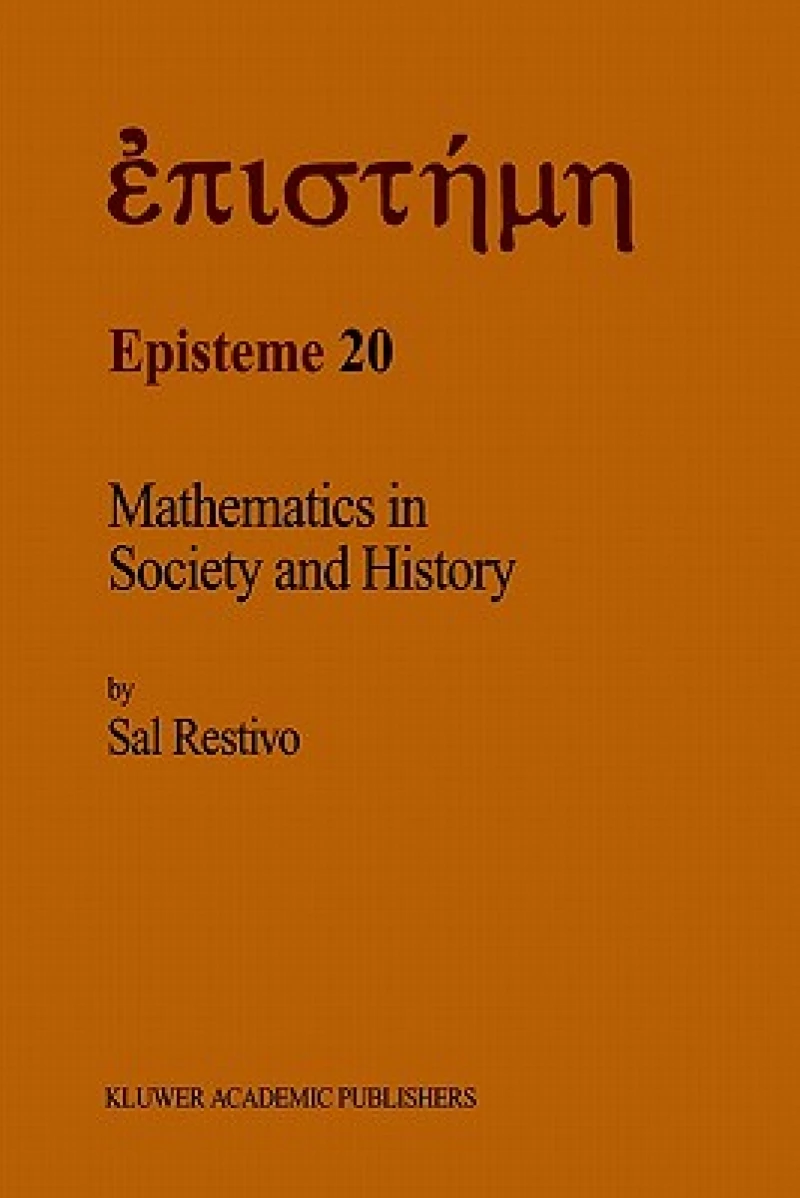
Deals with the general sociology of mathematics. This book provides examples of different ways of thinking about mathematics sociologically. It presents a survey of mathematical traditions that covers ancient China, the Arabic-Islamic world, India, and Europe.
Prologue. Part I: Introduction. 1. Mathematics and Culture. An introduction to Oswald Spengler''s pioneering work on `numbers and culture'' in The Decline of the West. This is the source of a `weak'' sociology of mathematical traditions, and a `strong'' sociology of mathematics as a social world (mathematics as social relations and worldview). The `weak'' perspective guides the discussion in Part II, the `strong'' perspective guides the discussion in Part III. 2. Mathematics from the Ground Up. The Social activities of everyday life in ancient societies give rise to arithmetic and geometry, the classical forms of mathematical work. Part II: Mathematical Traditions. 3. The Mathematics of Survival in China. From the legend of Yu the Great and the Lo River tortoise to the `golden age'' in T''ang. 4. Mathematics in Context: The Arabic-Islamic Golden Age. A `golden age of mathematics'' (700-1400 in the Arabic-Islamic world) is sketched with an emphasis on historical conditions and cultural settings. 5. Indian Mathematics: A History of Episodes. Sociological highlights from the history of Indian mathematics. 6. Mathematics and Renaissance in Japan. The seventeenth century `renaissance'' makes Japan a center of oriental mathematical work; the mathematical revolution ends abruptly with the consolidation of power by the Tokugawa shoguns. 7. Conflict, Social Change, and Mathematics in Europe. `Scandals'' are shown to reflect transitions to new conditions of competition and conflict: the cases of Cardan and Tartaglia (1540s), Newton and Leibniz (1670-1730), and Cauchy, Abel, and Galois (1826-1832) represent key transitional scandals from the `robber baron'' era. The Cantor-Kronecker case (late nineteenth century) represents a transition from the robber baron era to the era of `saintly politicians'' who emphasize the collective side of science in an era of competition between `schools'' of mathematics. The group of mathematicians known as Bourbaki is a key example. Appendix 1: African Mathematics and the Problem of Ethnoscience. Appendix 2: On Modes of Thought. Appendix 3: Mathematics and God. Part III: Math Worlds. 8. Mathematics as Representation. Survey of a wide range of issues, examples, and conjectures in the sociology of mathematics that bear on the problem of representation. 9. Foundations of the Sociology of Pure Mathematics. The sociological conditions behind experiencing and labeling mental states and products as `pure''. 10. The Social Relations of Pure Mathematics. Includes a sociological reading of Boole''s `laws of thought'' and of Kleene''s `metamathematics''. Bibliographic Epilogue. References. Index.
Get Mathematics in Society and History by at the best price and quality guaranteed only at Werezi Africa's largest book ecommerce store. The book was published by Kluwer Academic Publishers and it has pages.

