
Cart 0
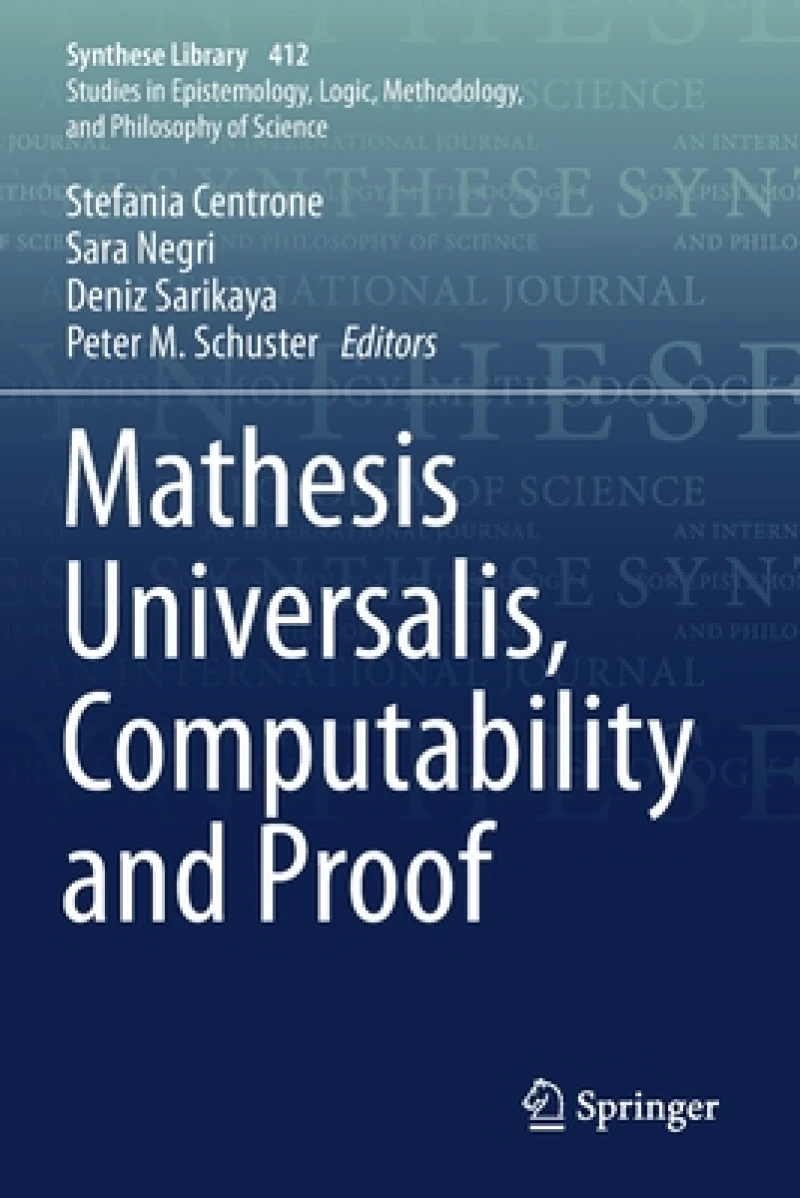
Mathesis Universalis, Computability and Proof
Click to zoom

Share this book

Mathesis Universalis, Computability and Proof

1st ed. 2019

Book Details

Format Paperback / Softback
Book Series Synthese Library
ISBN-10 3030204499
ISBN-13 9783030204495
Edition 1st ed. 2019
Publisher Springer Nature Switzerland AG
Imprint Springer Nature Switzerland AG
Country of Manufacture GB
Country of Publication GB
Publication Date Nov 6th, 2020
Print length 374 Pages
Ksh 19,800.00
Werezi Extended Catalogue 0 in stock

Delivery Location

Delivery fee: Select location

Secure
Quality
Fast
In a fragment entitled Elementa Nova Matheseos Universalis (1683?) Leibniz writes “the mathesis […] shall deliver the method through which things that are conceivable can be exactly determined”; in another fragment he takes the mathesis to be “the science of all things that are conceivable.” Leibniz considers all mathematical disciplines as branches of the mathesis and conceives the mathesis as a general science of forms applicable not only to magnitudes but to every object that exists in our imagination, i.e. that is possible at least in principle. As a general science of forms the mathesis investigates possible relations between “arbitrary objects” (“objets quelconques”). It is an abstract theory of combinations and relations among objects whatsoever. In 1810 the mathematician and philosopher Bernard Bolzano published a booklet entitled Contributions to a Better-Grounded Presentation of Mathematics. There is, according to him, a certain objective connection among the truths that are germane to a certain homogeneous field of objects: some truths are the “reasons” (“Gründe”) of others, and the latter are “consequences” (“Folgen”) of the former. The reason-consequence relation seems to be the counterpart of causality at the level of a relation between true propositions. Arigorous proof is characterized in this context as a proof that shows the reason of the proposition that is to be proven. Requirements imposed on rigorous proofs seem to anticipate normalization results in current proof theory. The contributors of Mathesis Universalis, Computability and Proof,  leading experts in the fields of computer science, mathematics, logic and philosophy, show the evolution of these and related ideas exploring topics in proof theory, computability theory, intuitionisticlogic, constructivism and reverse mathematics, delving deeply into a contextual examination of the relationship between mathematical rigor and demands for simplification. 

In a fragment entitled Elementa Nova Matheseos Universalis (1683?) Leibniz writes "the mathesis [...] shall deliver the method through which things that are conceivable can be exactly determined"; in another fragment he takes the mathesis to be "the science of all things that are conceivable." Leibniz considers all mathematical disciplines as branches of the mathesis and conceives the mathesis as a general science of forms applicable not only to magnitudes but to every object that exists in our imagination, i.e. that is possible at least in principle. As a general science of forms the mathesis investigates possible relations between "arbitrary objects" ("objets quelconques"). It is an abstract theory of combinations and relations among objects whatsoever.

In 1810 the mathematician and philosopher Bernard Bolzano published a booklet entitled Contributions to a Better-Grounded Presentation of Mathematics. There is, according to him, a certain objective connection among the truths that are germane to a certain homogeneous field of objects: some truths are the "reasons" ("Gründe") of others, and the latter are "consequences" ("Folgen") of the former. The reason-consequence relation seems to be the counterpart of causality at the level of a relation between true propositions. Arigorous proof is characterized in this context as a proof that shows the reason of the proposition that is to be proven. Requirements imposed on rigorous proofs seem to anticipate normalization results in current proof theory.

The contributors of Mathesis Universalis, Computability and Proof,  leading experts in the fields of computer science, mathematics, logic and philosophy, show the evolution of these and related ideas exploring topics in proof theory, computability theory, intuitionistic logic, constructivism and reverse mathematics, delving deeply into a contextual examination of the relationship between mathematical rigor and demands for simplification. 


Get Mathesis Universalis, Computability and Proof by at the best price and quality guaranteed only at Werezi Africa's largest book ecommerce store. The book was published by Springer Nature Switzerland AG and it has pages.


Mind, Body, & Spirit

Shopping Cart

Africa largest book store

Sub Total:
Ebooks

Digital Library
Coming Soon

Our digital collection is currently being curated to ensure the best possible reading experience on Werezi. We'll be launching our Ebooks platform shortly.