
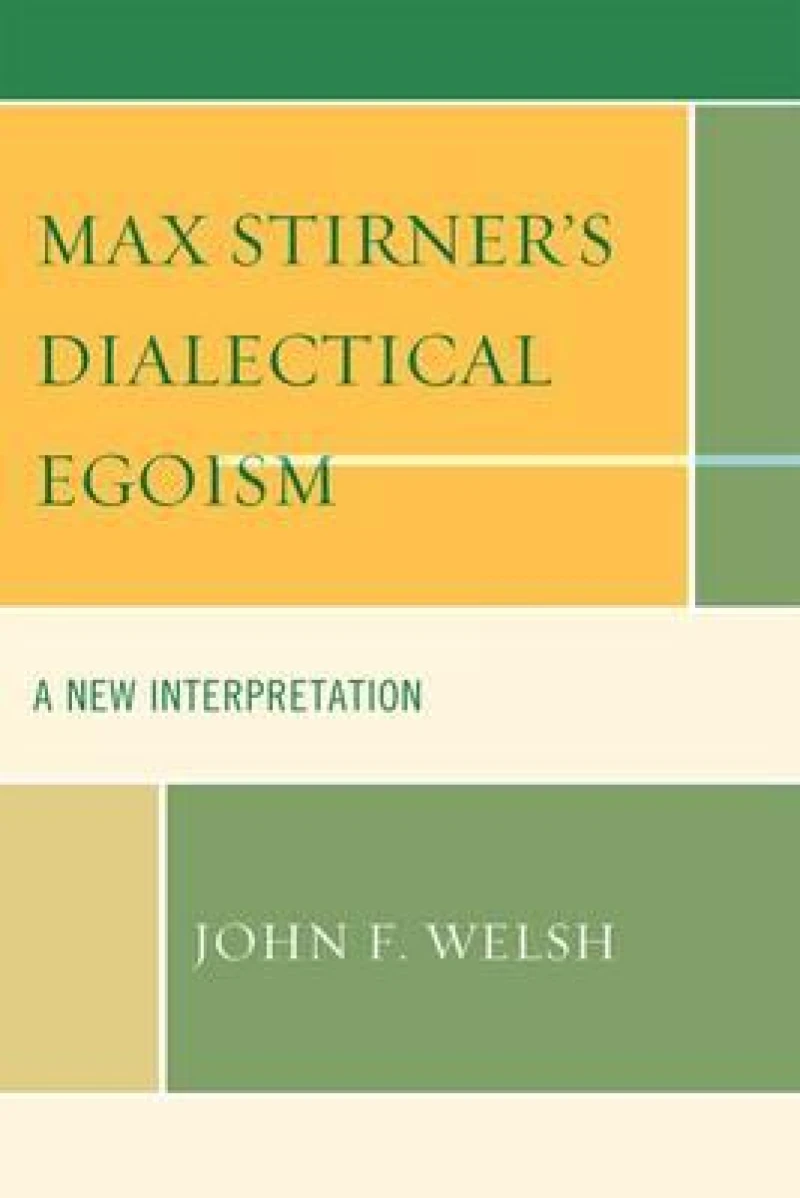
Max Stirner''s Dialectical Egoism : A New Interpretation
Book Details
Format
Hardback or Cased Book
ISBN-10
0739141554
ISBN-13
9780739141557
Publisher
Bloomsbury Publishing Plc
Imprint
Lexington Books
Country of Manufacture
GB
Country of Publication
GB
Publication Date
Sep 25th, 2010
Print length
304 Pages
Weight
612 grams
Dimensions
15.80 x 23.20 x 2.10 cms
Product Classification:
Political science & theoryPolitical science and theory
Ksh 21,350.00
Manufactured on Demand
0 in stock
Delivery Location
Delivery fee: Select location
Secure
Quality
Fast
Max Stirner (1806-1856) is recognized in the history of political thought because of his egoist classic The Ego and Its Own. Stirner was a student of Hegel, and a critic of the Young Hegelians and the emerging forms of socialist and communist thought in the 1840s. Max Stirner''s Dialectical Egoism: A New Interpretation examines Stirner''s thought as a critique of modernity, by which he meant the domination of culture and politics by humanist ideology. In Stirner''s view, "humanity" is the supreme being of modernity and "humanism" is the prevailing legitimation of social and political domination.
Welsh traces Stirner''s thought from his early essays to The Ego and Its Own and Stirner''s responses to his critics. He also examines how Benjamin Tucker, James L. Walker, and Dora Marsden applied Stirner''s dialectical egoism to the analysis of (a) the transformations of capitalism, (b) culture, ethics, and mass psychology, and (c) feminism, socialism, and communism. All three viewed Stirner as a champion of individuality against the collectivizing and homogenizing forces of the modern world.
Welsh also takes great care to dissociate Stirner''s thought from that of the other great egoist critic of modernity, Friedrich Nietzsche. He argues that the similarities in the dissidence of Stirner and Nietzsche are superficial. The book concludes with an interpretation of Stirner''s thought as a form of dialectical egoism that includes (a) a multi-tiered analysis of culture, society, and individuality; (b) the basic principles of Stirner''s view of the relationship between individuals and social organization; and (c) the forms of critique he employs. Stirner''s critique of modernity is a significant contribution to the growing literature on libertarianism, dialectical analysis, and post-modernism.
Welsh traces Stirner''s thought from his early essays to The Ego and Its Own and Stirner''s responses to his critics. He also examines how Benjamin Tucker, James L. Walker, and Dora Marsden applied Stirner''s dialectical egoism to the analysis of (a) the transformations of capitalism, (b) culture, ethics, and mass psychology, and (c) feminism, socialism, and communism. All three viewed Stirner as a champion of individuality against the collectivizing and homogenizing forces of the modern world.
Welsh also takes great care to dissociate Stirner''s thought from that of the other great egoist critic of modernity, Friedrich Nietzsche. He argues that the similarities in the dissidence of Stirner and Nietzsche are superficial. The book concludes with an interpretation of Stirner''s thought as a form of dialectical egoism that includes (a) a multi-tiered analysis of culture, society, and individuality; (b) the basic principles of Stirner''s view of the relationship between individuals and social organization; and (c) the forms of critique he employs. Stirner''s critique of modernity is a significant contribution to the growing literature on libertarianism, dialectical analysis, and post-modernism.
Get Max Stirner''s Dialectical Egoism by at the best price and quality guaranteed only at Werezi Africa's largest book ecommerce store. The book was published by Bloomsbury Publishing Plc and it has pages.

