
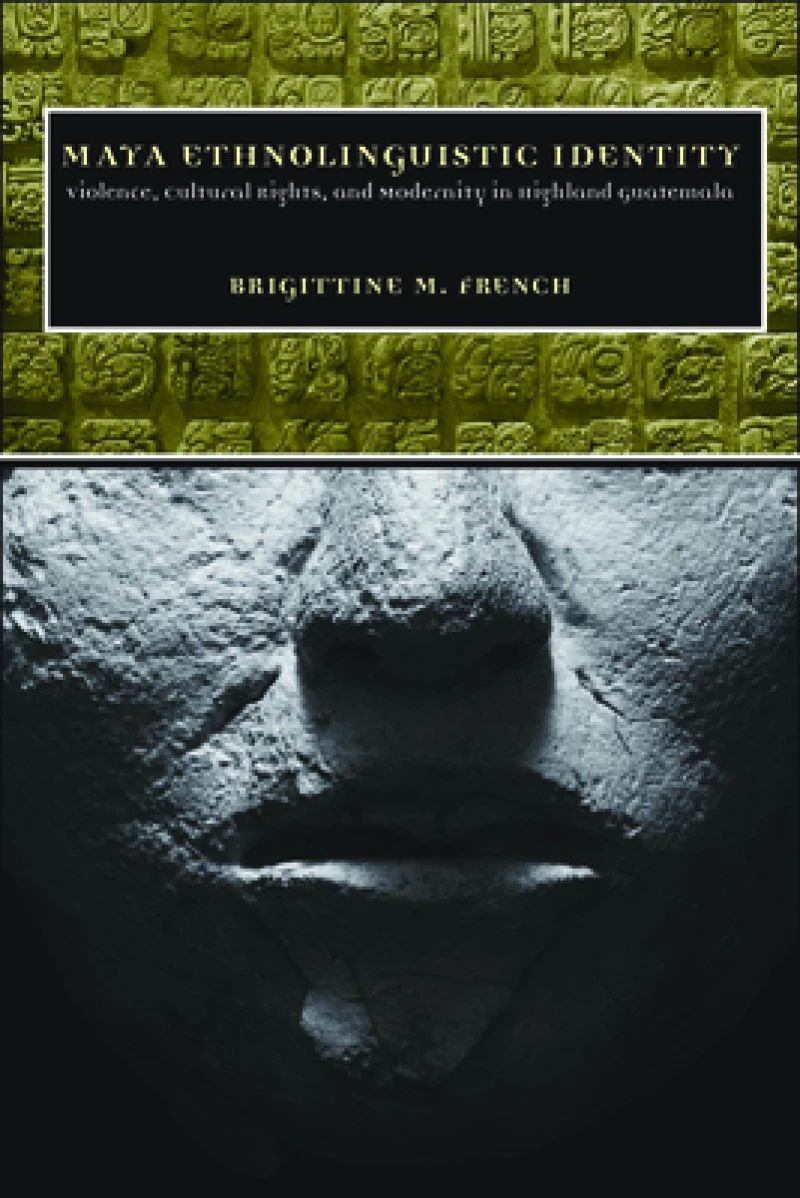
Maya Ethnolinguistic Identity : Violence, Cultural Rights, and Modernity in Highland Guatemala
Book Details
Format
Paperback / Softback
ISBN-10
0816542406
ISBN-13
9780816542406
Publisher
University of Arizona Press
Imprint
University of Arizona Press
Country of Manufacture
US
Country of Publication
GB
Publication Date
Aug 4th, 2020
Print length
192 Pages
Weight
262 grams
Dimensions
22.90 x 15.20 x 1.50 cms
Ksh 4,150.00
Werezi Extended Catalogue
0 in stock
Delivery Location
Delivery fee: Select location
Secure
Quality
Fast
In this valuable book, ethnographer and anthropologist Brigittine French mobilizes new critical-theoretical perspectives in linguistic anthropology, applying them to the politically charged context of contemporary Guatemala.
In this valuable book, ethnographer and anthropologist Brigittine French mobilizes new critical-theoretical perspectives in linguistic anthropology, applying them to the politically charged context of contemporary Guatemala. Beginning with an examination of the 'nationalist project' that has been ongoing since the end of the colonial period, French interrogates the 'Guatemalan/indigenous binary.' In Guatemala, 'Ladino' refers to the Spanish-speaking minority of the population, who are of mixed European, usually Spanish, and indigenous ancestry; 'Indian' is understood to mean the majority of Guatemala's population, who speak one of the twenty-one languages in the Maya linguistic groups of the country, although levels of bilingualism are very high among most Maya communities. As French shows, the Guatemalan state has actively promoted a racialized, essentialized notion of 'Indians' as an undifferentiated, inherently inferior group that has stood stubbornly in the way of national progress, unity, and development-which are, implicitly, the goals of 'true Guatemalans' (that is, Ladinos).
French shows, with useful examples, how constructions of language and collective identity are in fact strategies undertaken to serve the goals of institutions (including the government, the military, the educational system, and the church) and social actors (including linguists, scholars, and activists). But by incorporating in-depth fieldwork with groups that speak Kaqchikel and K'iche' along with analyses of Spanish-language discourses, Maya Ethnolinguistic Identity also shows how some individuals in urban, bilingual Indian communities have disrupted the essentializing projects of multiculturalism. And by focusing on ideologies of language, the author is able to explicitly link linguistic forms and functions with larger issues of consciousness, gender politics, social positions, and the forging of hegemonic power relations.
French shows, with useful examples, how constructions of language and collective identity are in fact strategies undertaken to serve the goals of institutions (including the government, the military, the educational system, and the church) and social actors (including linguists, scholars, and activists). But by incorporating in-depth fieldwork with groups that speak Kaqchikel and K'iche' along with analyses of Spanish-language discourses, Maya Ethnolinguistic Identity also shows how some individuals in urban, bilingual Indian communities have disrupted the essentializing projects of multiculturalism. And by focusing on ideologies of language, the author is able to explicitly link linguistic forms and functions with larger issues of consciousness, gender politics, social positions, and the forging of hegemonic power relations.
Get Maya Ethnolinguistic Identity by at the best price and quality guaranteed only at Werezi Africa's largest book ecommerce store. The book was published by University of Arizona Press and it has pages.

