
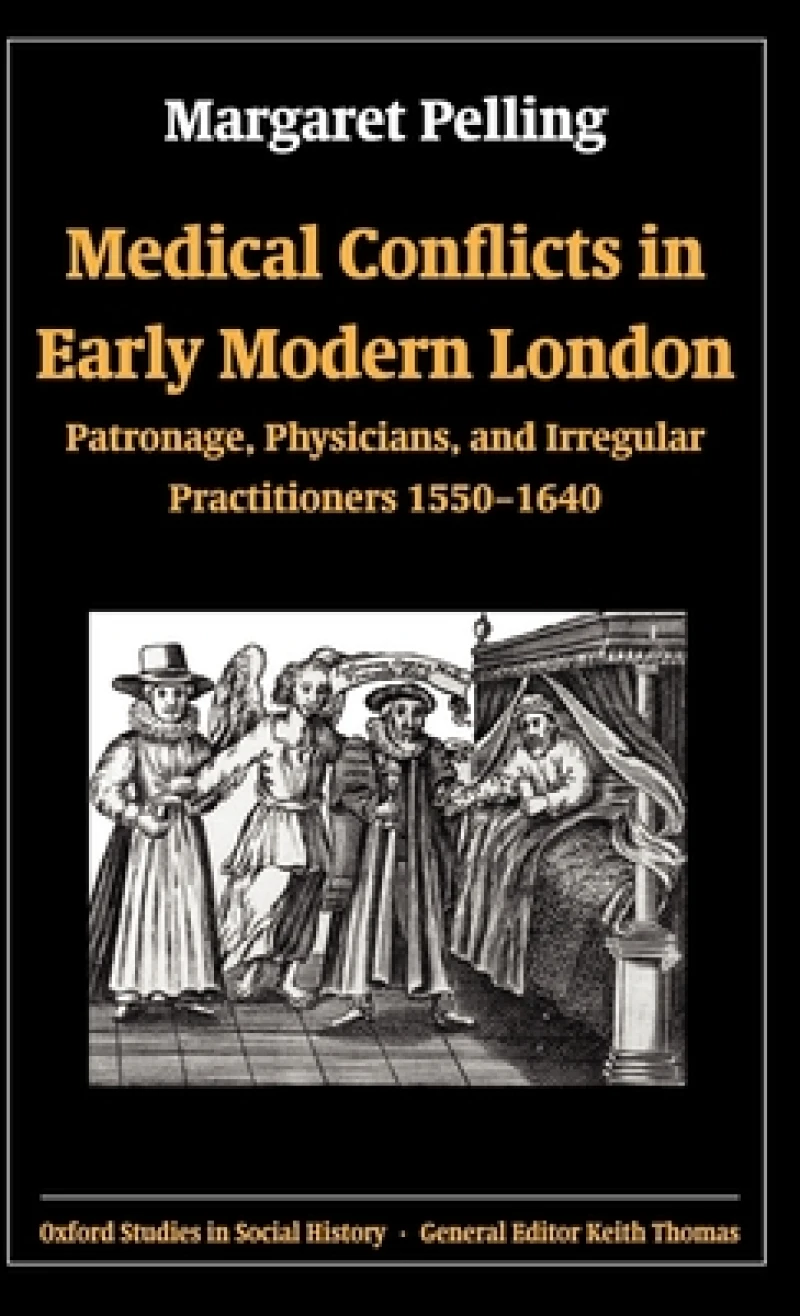
Medical Conflicts in Early Modern London : Patronage, Physicians, and Irregular Practitioners 1550-1640
Book Details
Format
Hardback or Cased Book
Book Series
Oxford Studies in Social History
ISBN-10
0199257809
ISBN-13
9780199257805
Publisher
Oxford University Press
Imprint
Oxford University Press
Country of Manufacture
GB
Country of Publication
GB
Publication Date
Jun 5th, 2003
Print length
428 Pages
Weight
676 grams
Dimensions
22.30 x 14.30 x 3.20 cms
Ksh 52,050.00
Manufactured on Demand
0 in stock
Delivery Location
Delivery fee: Select location
Secure
Quality
Fast
A comprehensive analysis of the single record, which details the multifarious medical practitioners in early modern London. It reveals the attitudes and realities in the conflict between the College of Physicians and the practitioners, male and female, whom the College regarded as illicit or irregular.
Physicians have had a major role in framing the middle-class values of modern western society, especially those relating to the professions. This book questions the bases of this hegemony, by looking first at the early modern physician''s insecurities in terms of status and gender, and then at the wider world of medicine in London which the College of Physicians sought to suppress. The College''s proceedings against irregular practitioners constitute a case-study in the regulation of an occupation critical for the well-being of contemporary Londoners. However, the College was, it is argued, an anomalous body, detached from most other forms of male authority in the urban context, and its claims lacked social recognition. It used stereotyping to construct an account designed for higher authority, but at the same time, its regulatory efforts were constantly undermined by the effects of patronage. The so-called irregular practitioners emerge as extremely diverse in country of origin, religious belief, and levels of formal education, yet the full analysis provided here also shows that most were literate, and that a significant number later became members of the College. Many were London artisans, barber-surgeons and apothecaries who can be seen as the ''excluded middle'' between the two better-known extremes of the physician and the quack. In suppressing artisan practitioners, the College was also seeking to suppress contractual or ''citizen'' medicine, an alternative system of structuring relations between the active patient and the practitioner which was fully integrated in contemporary urban custom and practice, but which has since disappeared. The College''s selective account also inadvertently reveals the existence of female artisans who practised medicine outside the household routinely and for payment. Although distorted by the College''s proximity to the Crown and to élite patrons, the Annals of the College give access to the rich variety of medical practice in early modern London and to the forms of resistance and self-presentation with which those outside the College justified, or denied, their identity as practitioners.
Get Medical Conflicts in Early Modern London by at the best price and quality guaranteed only at Werezi Africa's largest book ecommerce store. The book was published by Oxford University Press and it has pages.

