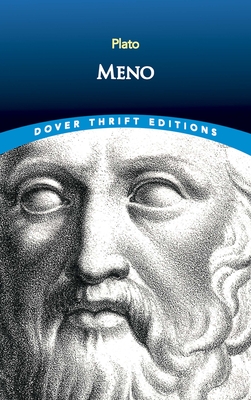
Meno
by
Plato
Book Details
Format
Paperback / softback
Book Series
Dover Thrift Editions
ISBN-10
0486831787
ISBN-13
9780486831787
Publisher
Dover Publications Inc.
Imprint
Dover Publications Inc.
Country of Manufacture
US
Country of Publication
GB
Publication Date
Apr 26th, 2019
Print length
96 Pages
Weight
82 grams
Dimensions
20.10 x 12.50 x 0.70 cms
Product Classification:
PhilosophyPhilosophy
KSh 550.00
Publisher Out of Stock
0 in stock
Delivery Location
Delivery fee: Select location
Secure
Quality
Fast
Important and influential Socratic dialogue addresses some of philosophy's most fundamental questions, including the definition of virtue and the nature and possibility of a priori (innate) knowledge. Jowett translation.
What is virtue? Can it be learned or is it innate? Is it possible to know things a priori (before experience)? In this important and influential Socratic dialogue, Plato addresses a wealth of philosophy's fundamental questions, including the difference between actually knowing something and merely maintaining a correct belief about it. The dialogue begins when Meno, a young aristocrat from Thessaly, confidently declares that he can define virtue – only to be reduced in short order to utter confusion, a fate common to those engaging in debate with Socrates. Meno's contention that a concept cannot be defined without knowledge of its nature leads to one of the most celebrated passages in the history of philosophy: Socrates asserts the doctrine of reincarnation, and by posing a mathematical puzzle to Meno's slave, demonstrates the existence of innate knowledge. This brief but profound dialogue, which forms the basis for subsequent examinations of a priori knowledge, appears here in the translation by the distinguished scholar Benjamin Jowett.
Get Meno by Plato at the best price and quality guaranteed only at Werezi Africa's largest book ecommerce store. The book was published by Dover Publications Inc. and it has 96 pages.
Customers Who Bought This Also Bought
Decolonizing Language and Other Revolutionary Ideas
KSh 2,350.00

How to Read a Book
KSh 2,000.00
Decolonizing Language and Other Revolutionary Ideas
KSh 3,600.00

Creative Act
KSh 3,250.00
Groundwork for the Metaphysics of Morals
KSh 2,000.00

Things in Nature Merely
KSh 2,000.00
Meditations – The Philosophy Classic
KSh 2,150.00

Great Ideas Social Contract
KSh 1,450.00
How to Be a Leader – An Ancient Guide to Wise Leadership
KSh 2,800.00
The Daily Laws
KSh 2,350.00

Three Critiques, 3-volume Set
KSh 14,000.00

Philosophical Dictionary
KSh 2,700.00