
Search

Categories

    • categories-img Jacket, Women
    • categories-img Woolend Jacket
    • categories-img Western denim
    • categories-img Mini Dresss
    • categories-img Jacket, Women
    • categories-img Woolend Jacket
    • categories-img Western denim
    • categories-img Mini Dresss
    • categories-img Jacket, Women
    • categories-img Woolend Jacket
    • categories-img Western denim
    • categories-img Mini Dresss
    • categories-img Jacket, Women
    • categories-img Woolend Jacket
    • categories-img Western denim
    • categories-img Mini Dresss
    • categories-img Jacket, Women
    • categories-img Woolend Jacket
    • categories-img Western denim
    • categories-img Mini Dresss

Filter By Price

$
-
$

Dietary Needs

Top Rated Product

product-img product-img

Modern Chair

$165.00
product-img product-img

Plastic Chair

$165.00
product-img product-img

Design Rooms

$165.00

Brands

  • Wooden
  • Chair
  • Modern
  • Fabric
  • Shoulder
  • Winter
  • Accessories
  • Dress

Welcome and thank you for visiting us. For any query call us on 0799 626 359 or Email [email protected]

Offcanvas Menu Open

Shopping Cart

Africa largest book store

Sub Total:

Search for any Title

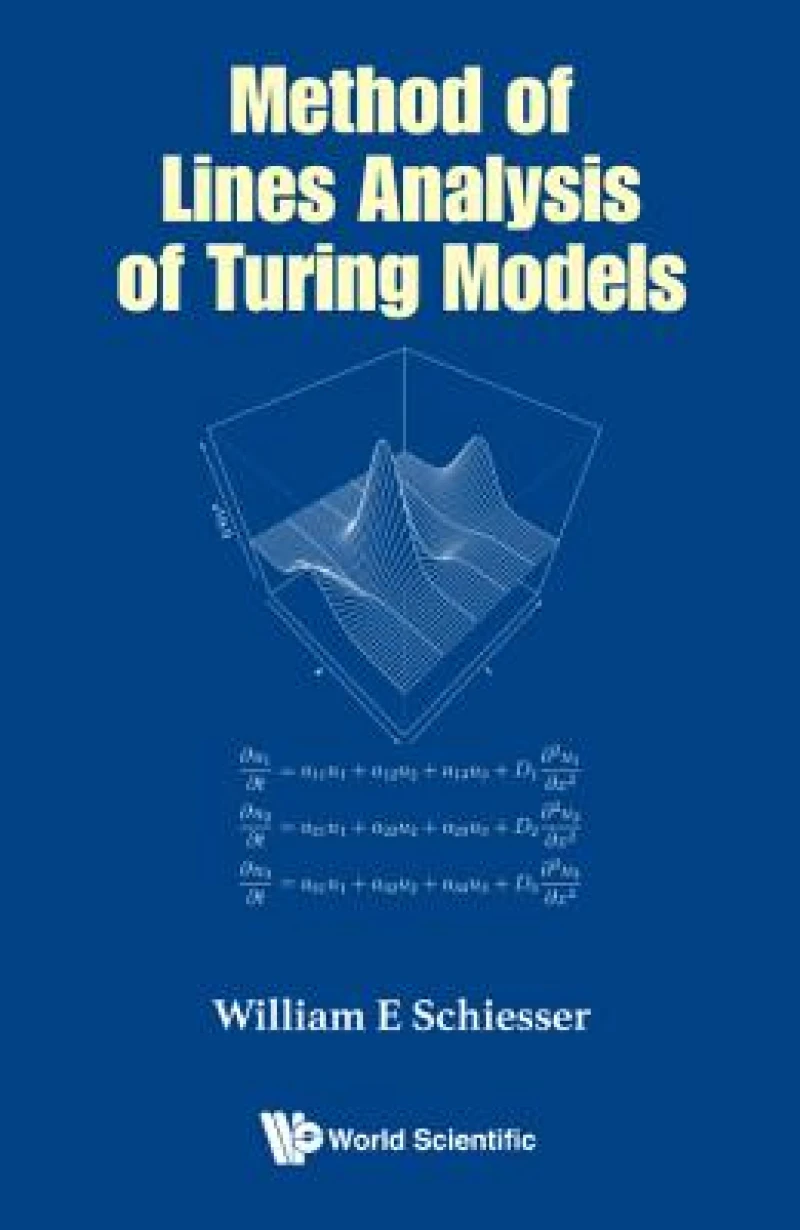
Method Of Lines Analysis Of Turing Models

By: (Author) William E Schiesser

Werezi Extended Catalogue
Delivery in 34 days

Ksh 13,850.00

Format: Hardback or Cased Book

ISBN-10: 9813226692

ISBN-13: 9789813226692

Publisher: World Scientific Publishing Co Pte Ltd

Imprint: World Scientific Publishing Co Pte Ltd

Country of Manufacture: GB

Country of Publication: GB

Publication Date: Aug 8th, 2017

Print length: 268 Pages

Product Classification: Mathematical modelling

Choose your Location

Shipping & Delivery

Door Delivery

Delivery fee

Delivery in 34 days

  • Description

  • Reviews

This book is directed toward the numerical integration (solution) of a system of partial differential equations (PDEs) that describes a combination of chemical reaction and diffusion, that is, reaction-diffusion PDEs. The particular form of the PDEs corresponds to a system discussed by Alan Turing and is therefore termed a Turing model.Specifically, Turing considered how a reaction-diffusion system can be formulated that does not have the usual smoothing properties of a diffusion (dispersion) system, and can, in fact, develop a spatial variation that might be interpreted as a form of morphogenesis, so he termed the chemicals as morphogens.Turing alluded to the important impact computers would have in the study of a morphogenic PDE system, but at the time (1952), computers were still not readily available. Therefore, his paper is based on analytical methods. Although computers have since been applied to Turing models, computer-based analysis is still not facilitated by a discussion of numerical algorithms and a readily available system of computer routines.The intent of this book is to provide a basic discussion of numerical methods and associated computer routines for reaction-diffusion systems of varying form. The presentation has a minimum of formal mathematics. Rather, the presentation is in terms of detailed examples, presented at an introductory level. This format should assist readers who are interested in developing computer-based analysis for reaction-diffusion PDE systems without having to first study numerical methods and computer programming (coding).The numerical examples are discussed in terms of: (1) numerical integration of the PDEs to demonstrate the spatiotemporal features of the solutions and (2) a numerical eigenvalue analysis that corroborates the observed temporal variation of the solutions. The resulting temporal variation of the 2D and 3D plots demonstrates how the solutions evolve dynamically, including oscillatory long-term behavior.In all of the examples, routines in R are presented and discussed in detail. The routines are available through this link so that the reader can execute the PDE models to reproduce the reported solutions, then experiment with the models, including extensions and application to alternative models.

This book is directed toward the numerical integration (solution) of a system of partial differential equations (PDEs) that describes a combination of chemical reaction and diffusion, that is, reaction-diffusion PDEs. The particular form of the PDEs corresponds to a system discussed by Alan Turing and is therefore termed a Turing model.

Specifically, Turing considered how a reaction-diffusion system can be formulated that does not have the usual smoothing properties of a diffusion (dispersion) system, and can, in fact, develop a spatial variation that might be interpreted as a form of morphogenesis, so he termed the chemicals as morphogens.

Turing alluded to the important impact computers would have in the study of a morphogenic PDE system, but at the time (1952), computers were still not readily available. Therefore, his paper is based on analytical methods. Although computers have since been applied to Turing models, computer-based analysis is still not facilitated by a discussion of numerical algorithms and a readily available system of computer routines.

The intent of this book is to provide a basic discussion of numerical methods and associated computer routines for reaction-diffusion systems of varying form. The presentation has a minimum of formal mathematics. Rather, the presentation is in terms of detailed examples, presented at an introductory level. This format should assist readers who are interested in developing computer-based analysis for reaction-diffusion PDE systems without having to first study numerical methods and computer programming (coding).

The numerical examples are discussed in terms of: (1) numerical integration of the PDEs to demonstrate the spatiotemporal features of the solutions and (2) a numerical eigenvalue analysis that corroborates the observed temporal variation of the solutions. The resulting temporal variation of the 2D and 3D plots demonstrates how the solutions evolve dynamically, including oscillatory long-term behavior.

In all of the examples, routines in R are presented and discussed in detail. The routines are available through this link so that the reader can execute the PDE models to reproduce the reported solutions, then experiment with the models, including extensions and application to alternative models.


Get Method Of Lines Analysis Of Turing Models by at the best price and quality guranteed only at Werezi Africa largest book ecommerce store. The book was published by World Scientific Publishing Co Pte Ltd and it has pages. Enjoy Shopping Best Offers & Deals on books Online from Werezi - Receive at your doorstep - Fast Delivery - Secure mode of Payment

Customer Reviews

Based on 0 reviews

Mind, Body, & Spirit
