
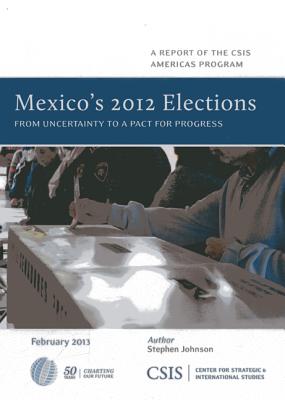
Mexico''s 2012 Elections : From Uncertainty to a Pact for Progress
Book Details
Format
Paperback / softback
Book Series
CSIS Reports
ISBN-10
1442224533
ISBN-13
9781442224537
Publisher
Centre for Strategic & International Studies,U.S.
Imprint
Centre for Strategic & International Studies,U.S.
Country of Manufacture
GB
Country of Publication
GB
Publication Date
Jun 7th, 2013
Print length
24 Pages
Weight
76 grams
Dimensions
27.90 x 21.60 x 0.50 cms
Product Classification:
Politics & governmentPolitics and governmentWarfare & defenceWarfare and defence
KSh 7,550.00
Currently unavailable
0 in stock
Delivery Location
Delivery fee: Select location
Secure
Quality
Fast
At the beginning of 2011, security defined the U.S.-Mexico relationship, and it was the issue that most observers thought would shape Mexico''s 2012 presidential, state, and local elections. Only two of Mexico''s three main parties, the National Action Party (PAN) and Democratic Revolutionary Party (PRD), had well-known positions on security and on themes such as economic liberalization, rule of law, and reform of the energy sector.
Get Mexico''s 2012 Elections by Stephen Johnson at the best price and quality guaranteed only at Werezi Africa's largest book ecommerce store. The book was published by Centre for Strategic & International Studies,U.S. and it has 24 pages.
Customers Who Bought This Also Bought

Regime Change
KSh 5,050.00

Art of War / The Book of Lord Shang
KSh 1,100.00
Wretched of the Earth
KSh 2,000.00

White Saviorism In International Development
KSh 3,800.00

How To Do Nothing
KSh 2,700.00

How Civil Wars Start
KSh 2,000.00

Tomorrow Is Yesterday
KSh 4,700.00

The Thinking Machine
KSh 2,350.00

Second Treatise of Government – Norton Library
KSh 1,600.00

Becoming
KSh 2,350.00

A River in Darkness
KSh 1,250.00
Warning to the West
KSh 1,600.00
More by Stephen Johnson

Music Lessons: Seven Composers and What They Taught Me
KSh 2,900.00

Lost Railways of Galway and the North West
KSh 1,600.00

polyam blues.
KSh 1,600.00

Iran''s Influence in the Americas
KSh 9,900.00

Police Reform in Latin America
KSh 9,000.00

The Eighth
KSh 2,350.00

Rome and Its Empire (Routledge Revivals)
KSh 7,700.00
How Shostakovich Changed My Mind
KSh 2,900.00
Rome and Its Empire (Routledge Revivals)
KSh 4,850.00

Later Roman Britain (Routledge Revivals)
KSh 33,850.00

Lost Railways of County Donegal
KSh 2,150.00
Opposition Politics in Japan
KSh 30,950.00
