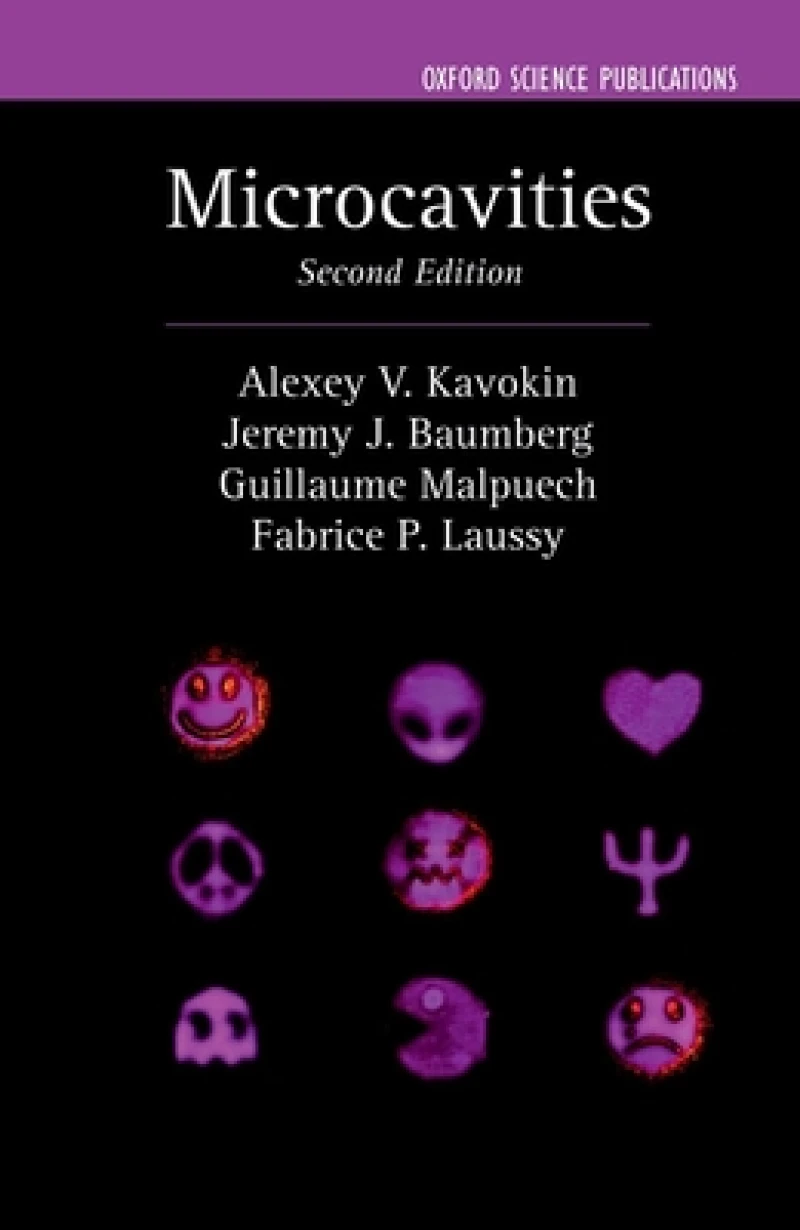
Microcavities
2 Revised edition
Book Details
Format
Hardback or Cased Book
Book Series
Series on Semiconductor Science and Technology
ISBN-10
0198782993
ISBN-13
9780198782995
Edition
2 Revised edition
Publisher
Oxford University Press
Imprint
Oxford University Press
Country of Manufacture
GB
Country of Publication
GB
Publication Date
May 11th, 2017
Print length
624 Pages
Weight
1,146 grams
Dimensions
16.30 x 24.10 x 3.70 cms
Ksh 17,400.00
Werezi Extended Catalogue
0 in stock
Delivery Location
Delivery fee: Select location
Secure
Quality
Fast
This is the first book to cover a new and rapidly developing research field in physics. Miniaturized solid state structures confining light, called microcavities, give rise to new devices which exploit the quantum physics of light matter interactions.
Microcavities are semiconductor, metal, or dielectric structures providing optical confinement in one, two or three dimensions. At the end of the 20th century, microcavities have attracted attention due to the discovery of a strong exciton-light coupling regime allowing for the formation of superposition light-matter quasiparticles: exciton-polaritons. In the following century several remarkable effects have been discovered in microcavities, including the Bose-Einstein condensation of exciton-polaritons, polariton lasing, superfluidity, optical spin Hall and spin Meissner effects, amongst other discoveries. Currently, polariton devices exploiting the bosonic stimulation effects at room temperature are being developed by laboratories across the world. This book addresses the physics of microcavities: from classical to quantum optics, from a Boltzmann gas to a superfluid. It provides the theoretical background needed for understanding the complex phenomena in coupled light-matter systems, and it presents a broad overview of experimental progress in the physics of microcavities.
Get Microcavities by at the best price and quality guaranteed only at Werezi Africa's largest book ecommerce store. The book was published by Oxford University Press and it has pages.