
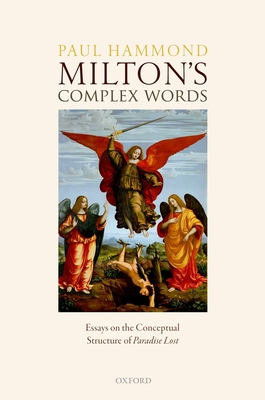
Milton's Complex Words : Essays on the Conceptual Structure of Paradise Lost
Book Details
Format
Hardback
ISBN-10
0198810113
ISBN-13
9780198810117
Publisher
Oxford University Press
Imprint
Oxford University Press
Country of Manufacture
GB
Country of Publication
GB
Publication Date
Nov 30th, 2017
Print length
498 Pages
Weight
912 grams
Dimensions
16.60 x 24.20 x 3.90 cms
Product Classification:
Literary studies: c 1500 to c 1800Literary studies: poetry & poets
KSh 25,900.00
Currently unavailable
0 in stock
Delivery Location
Delivery fee: Select location
Secure
Quality
Fast
Explores the specific meanings of key words in Milton's Paradise Lost and the diverse ways in which the characters of Milton's poem use and misuse these concepts.
Every major poet or philosopher develops their own distinctive semantic field around those terms which matter most to them, or which contribute most profoundly to the imagined world of a particular work. This book explores the specific meanings which Milton develops around key words in Paradise Lost. Some of these are theological or philosophical terms (e.g. ''evil'', ''grace'', ''reason''); others are words which shape the imagined world of the poem (e.g. ''dark'', ''fall'', ''within''); yet others are small words or even prefixes which subtly move the argument in new directions (e.g. ''if'', ''not'', ''re-''). Milton seems to expect his readers to be alert to the special semantic field which he creates around such words, often by infusing them with biblical and literary connotations, and activating their etymological roots; alert also to the patterns created by the repetitions of such words, and particularly to their diverse use (and often their blatant misuse) by different characters. To understand the migrations and malleability of key words is part of the education of Milton''s reader.
Get Milton's Complex Words by Prof Paul Hammond at the best price and quality guaranteed only at Werezi Africa's largest book ecommerce store. The book was published by Oxford University Press and it has 498 pages.
Customers Who Bought This Also Bought
Arabian Nights'' Entertainments
KSh 2,950.00
Robinson Crusoe
KSh 1,450.00
Metaphysical Poetry
KSh 2,350.00
A Portrait of the Artist as a Young Man
KSh 1,250.00

Shakespeare Book
KSh 4,250.00
Don Quixote de la Mancha
KSh 2,150.00
Lorna Doone
KSh 2,000.00
Tom Jones
KSh 5,400.00
Tom Jones
KSh 2,250.00
Micromégas and Other Short Fictions
KSh 2,350.00
Murder Among Friends
KSh 22,750.00

Hamlet: Poem Unlimited
KSh 1,800.00

