
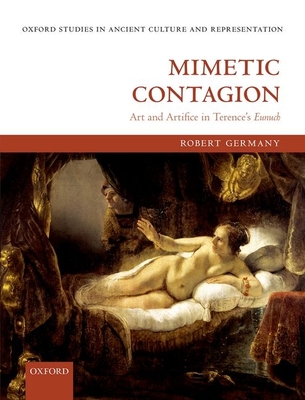
Mimetic Contagion : Art and Artifice in Terence's Eunuch
Book Details
Format
Hardback
Book Series
Oxford Studies in Ancient Culture Representation
ISBN-10
0198738730
ISBN-13
9780198738732
Publisher
Oxford University Press
Imprint
Oxford University Press
Country of Manufacture
GB
Country of Publication
GB
Publication Date
Oct 27th, 2016
Print length
212 Pages
Weight
602 grams
Dimensions
20.00 x 25.40 x 1.90 cms
Product Classification:
Ancient RomeLatinBCE period – ProtohistoryClassical styleLiterary studies: ancient, classical and medievalLiterary studies: classical, early & medievalLiterary studies: plays & playwrightsLiterary studies: plays and playwrightsEuropean historyClassical history / classical civilisationAncient historyEuropean history
KSh 20,450.00
Currently unavailable
0 in stock
Delivery Location
Delivery fee: Select location
Secure
Quality
Fast
This volume considers the phenomenon of mimetic contagion, whereby works of art draw viewers into direct imitation of themselves, and how it operates within specific historical contexts. Terence's Eunuch is used as a case study, situating the motif within the peculiarities of mid-second-century BC Rome and its anxieties about the power of art.
When we are confronted with a work of art, what is its effect on us? In contrast to post-Enlightenment conceptions, which tend to restrict themselves to aesthetic or discursive responses, the ancient Greeks and Romans often conceived works of art as having a more dynamic effect on their viewers, inspiring them to direct imitation of what they saw represented. This notion of ''mimetic contagion'' was a persistent and widespread mode of framing response to art across the ancient world, discernible in both popular and elevated cultural forms, yet deployed differently in various historical contexts; it is only under the specificity of a particular cultural moment''s concerns that it becomes most useful as a lens for understanding how that culture is attempting to negotiate the problems of representation. After framing the phenomenon in terms general enough to be applicable across many periods, literary genres, and artistic media, this volume takes a particular literary work, Terence''s Eunuch, as a starting point, both as a vivid example of this extensive pattern, and as a case study situating use of the motif within the peculiarities of a particular historical moment, in this case mid-second-century BC Rome and its anxieties about the power of art. One of the features of mimetic contagion frequently noted in this study is its capacity to render the operation of a particular work of art an emblem for the effect of representation more generally, and this is certainly the case in the Eunuch, whereby the painting at the centre of the play functions as a metatheatrical figure for the dynamics of mimesis throughout, illustrating how the concept may function as the key to a particular literary work. Although mimetic contagion is only one available Greco-Roman strategy for understanding the power of art, by offering an extended reading of a single work of literature through this lens, this volume demonstrates what ramifications closer attention to it might have for modern readers and literary criticism.
Get Mimetic Contagion by The late Robert Germany at the best price and quality guaranteed only at Werezi Africa's largest book ecommerce store. The book was published by Oxford University Press and it has 212 pages.
Customers Who Bought This Also Bought
The Odyssey
KSh 1,800.00
The Odyssey
KSh 1,600.00
The Divine Comedy
KSh 2,350.00
Annals
KSh 2,350.00
Classical Literary Criticism
KSh 2,350.00
Great Dialogues of Plato
KSh 1,450.00
The Divine Comedy
KSh 2,700.00
The Iliad
KSh 1,800.00

The Masnavi, Book Six
KSh 2,000.00

The Masnavi, Book Five
KSh 1,800.00
Chaucer's Pardoner and Gender Theory
KSh 8,100.00
Classical Literary Criticism
KSh 1,800.00
