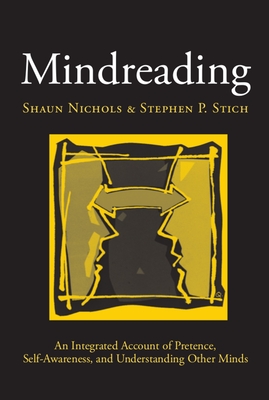
Mindreading : An Integrated Account of Pretence, Self-Awareness, and Understanding Other Minds
Book Details
Format
Paperback / softback
Book Series
Oxford Cognitive Science Series
ISBN-10
0198236107
ISBN-13
9780198236108
Publisher
Oxford University Press
Imprint
Oxford University Press
Country of Manufacture
GB
Country of Publication
GB
Publication Date
Sep 4th, 2003
Print length
246 Pages
Weight
364 grams
Dimensions
23.30 x 15.70 x 1.40 cms
Product Classification:
Philosophy of mindCognitivism, cognitive theoryCognition & cognitive psychology
KSh 10,550.00
Temporarily out of stock, due soon
0 in stock
Delivery Location
Delivery fee: Select location
Secure
Quality
Fast
The everyday capacity to understand the mind, or 'mindreading', plays an enormous role in our ordinary lives. Shaun Nichols and Stephen Stich provide a detailed and integrated account of the intricate web of mental components underlying this fascinating and multifarious skill.
The everyday capacity to understand the mind, fancifully dubbed ''mindreading'', plays an enormous role in our lives. In the latter half of the 20th century mindreading became the object of sustained scientific and theoretical research, capturing the attention of a wide range of disciplines, including philosophy, developmental psychology, behavioral ecology, anthropology, and cognitive psychopathology. What has been missing is a detailed and integrated account of the mental components that underlie this remarkable capacity. Nichols and Stich develop and defend a new account of the psychological mechanisms underlying mindreading. They maintain that it is, as common sense would suggest, vital to distinguish between reading others'' minds and reading one''s own. In reading other minds, the imagination plays a central role. As a result, the authors begin with an explicit and systematic account of pretence and imagination which proposes that pretence representations are contained in a separate mental workspace, the ''Possible World Box'', which is part of the basic architecture of the human mind. The mechanisms underlying pretence get recruited when people attempt to understand others and predict their behaviour. In some cases, we use our own mental mechanisms to simulate the mental processes of another, as suggested by the ''simulation theory'' of mindreading. However, mindreading also implicates very different kinds of mechanisms that rely on rich bodies of information, as suggested by information-based accounts of mindreading. In addition, the authors argue, reading other minds involves important processes that don''t fit into either category. None of these mechanisms, though, explain how we read our own minds, which, according to the authors, requires invoking an entirely independent set of mechanisms.What we find, then, is an intricate web of mental components to explain our fascinating and multifarious knack of understanding minds. This account provides a valuable framework for future work on mindreading and has broad implications for philosophical debates that have surrounded the issue for the last quarter century.
Get Mindreading by Shaun Nichols, Stephen P. Stich at the best price and quality guaranteed only at Werezi Africa's largest book ecommerce store. The book was published by Oxford University Press and it has 246 pages.
Customers Who Bought This Also Bought

Xmeditations
KSh 700.00
Order of Time
KSh 2,350.00

Being and Nothingness
KSh 7,300.00

The Analects
KSh 2,350.00

The Life Of The Mind
KSh 3,950.00
The Kybalion - Hermetic Philosophy - Revised and Updated Edition
KSh 2,000.00

Xrepublic
KSh 850.00

Aristotle''s De Anima
KSh 3,550.00

Xrepublic
KSh 1,450.00
Sharing Thoughts
KSh 17,000.00

Vocation of Man
KSh 2,500.00

Treatise Concerning the Principles of Human Knowledge
KSh 2,000.00