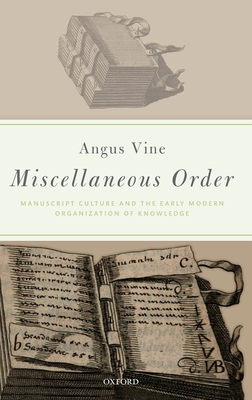
Miscellaneous Order : Manuscript Culture and the Early Modern Organization of Knowledge
by
Angus Vine
Book Details
Format
Hardback
ISBN-10
0198809700
ISBN-13
9780198809708
Publisher
Oxford University Press
Imprint
Oxford University Press
Country of Manufacture
GB
Country of Publication
GB
Publication Date
Jan 24th, 2019
Print length
302 Pages
Weight
590 grams
Dimensions
16.60 x 24.20 x 2.20 cms
Product Classification:
Literary studies: general
KSh 19,500.00
Currently unavailable
0 in stock
Delivery Location
Delivery fee: Select location
Secure
Quality
Fast
Explores the connection between miscellaneity and the organization of knowledge in the early modern period and the sophisticated organizational strategies that lay behind early modern miscellanies and notebooks to offer a re-evaluation of the early modern understanding of transcription itself.
This book examines one of the most pervasive, but also perplexing, textual phenomena of the early modern world: the manuscript miscellany. Faced with multiple problems of definition, categorization, and (often conflicting) terminology, modern scholars have tended to dismiss the miscellany as disorganized and chaotic. Miscellaneous Order radically challenges that view by uncovering the various forms of organization and order previously hidden in early modern manuscript books. Drawing on original literary and historical research, and examining both the materiality of early modern manuscripts and their contents, this book sheds new light on the transcriptive and archival practices of early modern Britain, as well as on the broader intellectual context of manuscript culture and its scholarly afterlives.Based on extensive archival research, and interdisciplinary in both subject and matter, Miscellaneous Order focuses on the myriad kinds of manuscript compiled and produced in the early modern era. Showing that the miscellany was essential to the organization of knowledge across a range of genres and disciplines, from poetry to science, and from recipe books to accounts, it proposes a new model for understanding the proliferation of manuscript material in the sixteenth and seventeenth centuries. By restoring attention to ''miscellaneous order'' in this way, it shows that we have fundamentally misunderstood how early modern men and women read, wrote, and thought. Rather than a textual form characterized by an absence of order, the miscellany, it argues, operated as an epistemically and aesthetically productive system throughout the early modern period.
Get Miscellaneous Order by Angus Vine at the best price and quality guaranteed only at Werezi Africa's largest book ecommerce store. The book was published by Oxford University Press and it has 302 pages.
Customers Who Bought This Also Bought

How to Read a Book
KSh 2,000.00

Decolonising the Mind
KSh 4,700.00

How to Read & Why
KSh 2,350.00

Arabian Nights'' Entertainments
KSh 2,950.00
In the Wake
KSh 3,600.00
The Birth of Tragedy
KSh 1,800.00

Against Nature
KSh 1,800.00

The White Album
KSh 3,250.00
Robinson Crusoe
KSh 1,450.00
Metaphysical Poetry
KSh 2,350.00
Reading Lessons
KSh 2,350.00

Literature Book
KSh 4,250.00