
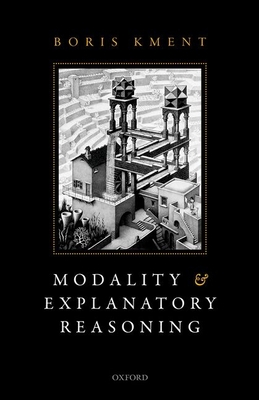
Modality and Explanatory Reasoning
by
Boris Kment
Book Details
Format
Hardback
ISBN-10
0199604681
ISBN-13
9780199604685
Publisher
Oxford University Press
Imprint
Oxford University Press
Country of Manufacture
GB
Country of Publication
GB
Publication Date
Sep 18th, 2014
Print length
376 Pages
Weight
720 grams
Dimensions
16.30 x 23.70 x 2.70 cms
Product Classification:
Philosophy of languagePhilosophy: metaphysics & ontologyPhilosophy: logic
KSh 22,000.00
Currently unavailable
0 in stock
Delivery Location
Delivery fee: Select location
Secure
Quality
Fast
Boris Kment takes a new approach to the study of modality that emphasises the origin of modal notions in everyday thought. He argues that the concepts of necessity and possibility originate in counterfactual reasoning, which allows us to investigate explanatory connections. Contrary to accepted views, explanation is more fundamental than modality.
Since the ground-breaking work of Saul Kripke, David Lewis, and others in the 1960s and 70s, one dominant interest of analytic philosophers has been in modal truths, which concern the question what is possible and what is necessary. However, there is considerable controversy over the source and nature of necessity. In Modality and Explanatory Reasoning, Boris Kment takes a novel approach to the study of modality that places special emphasis on understanding the origin of modal notions in everyday thought. Kment argues that the concepts of necessity and possibility originate in a common type of thought experiment--counterfactual reasoning--that allows us to investigate explanatory connections. This procedure is closely related to the controlled experiments of empirical science. Necessity is defined in terms of causation and other forms of explanation such as grounding, a relation that connects metaphysically fundamental facts to non-fundamental ones. Therefore, contrary to a widespread view, explanation is more fundamental than modality. The study of modal facts is important for philosophy, not because these facts are of much metaphysical interest in their own right, but because they provide evidence about explanatory relationships. In the course of developing this position, the book offers new accounts of possible and impossible worlds , counterfactual conditionals, essential truths and their role in grounding, and a novel theory of how counterfactuals relate to causation and explanation.
Get Modality and Explanatory Reasoning by Boris Kment at the best price and quality guaranteed only at Werezi Africa's largest book ecommerce store. The book was published by Oxford University Press and it has 376 pages.
Customers Who Bought This Also Bought

Recognising the Stranger
KSh 1,800.00
The Origin of Language
KSh 4,500.00
Sharing Thoughts
KSh 17,000.00
An Inquiry Into Meaning and Truth
KSh 3,750.00
Semiotics and the Philosophy of Language
KSh 3,400.00
An Introduction to Logic
KSh 6,650.00

Walker Percy''s Search for Community
KSh 5,950.00
Film Figures
KSh 16,450.00

The Tacit Dimensions of Language and Logic
KSh 15,800.00

Metaphors in Action
KSh 21,600.00
Frontiers in Semiotics
KSh 3,000.00

A Theory of Death
KSh 11,900.00

