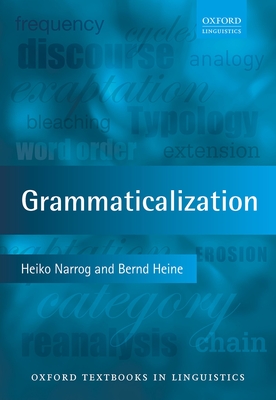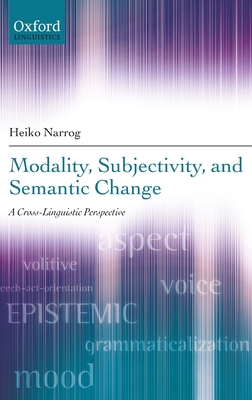
Modality, Subjectivity, and Semantic Change : A Cross-Linguistic Perspective
by
Heiko Narrog
Book Details
Format
Hardback
ISBN-10
0199694370
ISBN-13
9780199694372
Publisher
Oxford University Press
Imprint
Oxford University Press
Country of Manufacture
GB
Country of Publication
GB
Publication Date
Jul 19th, 2012
Print length
348 Pages
Weight
686 grams
Dimensions
24.00 x 16.40 x 2.40 cms
Product Classification:
Philosophy of languageSemantics, discourse analysis, etc
KSh 27,400.00
Temporarily out of stock, due soon
0 in stock
Delivery Location
Delivery fee: Select location
Secure
Quality
Fast
This book is a cross-linguistic exploration of semantic and functional change in modal markers. With a focus on Japanese and to a lesser extent Chinese the book is a countercheck to hypotheses built on the Indo-European languages. It also contains numerous illustrations from other languages.
This book is a cross-linguistic exploration of semantic and functional change in modal markers. Its approach is broadly functional typological but makes frequent reference to work in formal semantics by scholars such as Angelika Kratzer and Paul Portner. The author starts by considering what modality is and how it relates to and differs from subjectivity. He argues that modality cannot be defined in terms of subjectivity: both concepts are independent of each other, the first exhibiting different degrees of subjectivity, and the second being operative in a much wider range of grammatical and lexical categories. Subjectivity, he suggests, should not be defined solely in terms of performativity, evidentiality, or construal, but rather from the interplay of multiple semantic and pragmatic factors. He then presents a two-dimensional model for the descriptive representation of modality, based on the notion that among the many aspects of modal meaning, volitivity and speech-act-orientation versus event-orientation are two of its most salient parameters. He shows that it is especially the dimension of speech-act orientation versus event-orientation, parallel to category climbing in syntax, that is operative in diachronic change. Numerous examples of diachronic change within modality and between modality and other categories are then examined with respect to their directionality. With a focus on Japanese and to a lesser extent Chinese the book is a countercheck to hypotheses built on the Indo-European languages. It also contains numerous illustrations from other languages.
Get Modality, Subjectivity, and Semantic Change by Heiko Narrog at the best price and quality guaranteed only at Werezi Africa's largest book ecommerce store. The book was published by Oxford University Press and it has 348 pages.
Customers Who Bought This Also Bought

Recognising the Stranger
KSh 1,800.00

The Origin of Language
KSh 4,500.00
Sharing Thoughts
KSh 17,000.00

An Inquiry Into Meaning and Truth
KSh 3,750.00
Semiotics and the Philosophy of Language
KSh 3,400.00

An Introduction to Logic
KSh 6,650.00

Walker Percy''s Search for Community
KSh 5,950.00
Film Figures
KSh 16,450.00

The Tacit Dimensions of Language and Logic
KSh 15,800.00

Metaphors in Action
KSh 21,600.00
Frontiers in Semiotics
KSh 3,000.00

A Theory of Death
KSh 11,900.00