
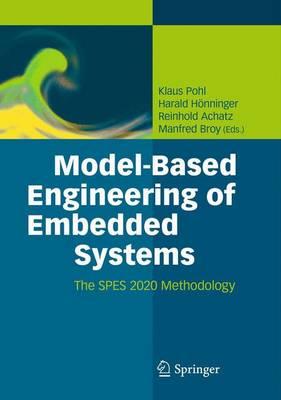
Model-Based Engineering of Embedded Systems : The SPES 2020 Methodology
Book Details
Format
Hardback
ISBN-10
3642346138
ISBN-13
9783642346132
Publisher
Springer-Verlag Berlin and Heidelberg GmbH & Co. KG
Imprint
Springer-Verlag Berlin and Heidelberg GmbH & Co. K
Country of Manufacture
DE
Country of Publication
GB
Publication Date
Nov 9th, 2012
Print length
304 Pages
Product Classification:
Computer aided manufacture (CAM)Automotive technology & tradesAutomotive technology and tradesAerospace & aviation technologyAerospace and aviation technologyAstronauticsDigital and Information technology: general topicsInformation technology: general issuesSoftware EngineeringExpert systems / knowledge-based systems
KSh 11,700.00
Currently unavailable
0 in stock
Delivery Location
Delivery fee: Select location
Secure
Quality
Fast
This book offers a comprehensive guide to model-based engineering of embedded systems, with sections titled Starting Point, SPES Modeling Theory, Application and Evaluation of the SPES Methodology and Impact of the SPES Methodology.
Embedded systems have long become essential in application areas in which human control is impossible or infeasible. The development of modern embedded systems is becoming increasingly difficult and challenging because of their overall system complexity, their tighter and cross-functional integration, the increasing requirements concerning safety and real-time behavior, and the need to reduce development and operation costs. This book provides a comprehensive overview of the Software Platform Embedded Systems (SPES) modeling framework and demonstrates its applicability in embedded system development in various industry domains such as automation, automotive, avionics, energy, and healthcare. In SPES 2020, twenty-one partners from academia and industry have joined forces in order to develop and evaluate in different industrial domains a modeling framework that reflects the current state of the art in embedded systems engineering. The content of this book is structured in four parts. Part I “Starting Point” discusses the status quo of embedded systems development and model-based engineering, and summarizes the key requirements faced when developing embedded systems in different application domains. Part II “The SPES Modeling Framework” describes the SPES modeling framework. Part III “Application and Evaluation of the SPES Modeling Framework” reports on the validation steps taken to ensure that the framework met the requirements discussed in Part I. Finally, Part IV “Impact of the SPES Modeling Framework” summarizes the results achieved and provides an outlook on future work. The book is mainly aimed at professionals and practitioners who deal with the development of embedded systems on a daily basis. Researchers in academia and industry may use it as a compendium for the requirements and state-of-the-art solution concepts for embedded systems development.
Get Model-Based Engineering of Embedded Systems by Harald Hönninger at the best price and quality guaranteed only at Werezi Africa's largest book ecommerce store. The book was published by Springer-Verlag Berlin and Heidelberg GmbH & Co. KG and it has 304 pages.
Customers Who Bought This Also Bought

8th EAI International Conference on Computer Science and Engineering in Health Services
KSh 39,600.00

Intelligent Patient Management
KSh 32,400.00

The CAPRISA Clinical Trials
KSh 21,600.00

Machine Learning Methods for Multi-omics Data Integration
KSh 36,000.00

Farming Human Pathogens
KSh 16,200.00

Mobile Technologies for Smart Healthcare System Design
KSh 27,000.00

Process Control Case Histories
KSh 5,200.00

Industrial Internet of Things
KSh 50,400.00

Drug Discovery and Telemedicine
KSh 17,550.00

Innovative Business Strategies
KSh 18,700.00

AI Adoption in Healthcare Industry 4.0
KSh 23,400.00

Driver Training for Automated Vehicles
KSh 26,300.00
More in This Genre
8th EAI International Conference on Computer Science and Engineering in Health Services
KSh 39,600.00
Intelligent Patient Management
KSh 32,400.00
The CAPRISA Clinical Trials
KSh 21,600.00
Machine Learning Methods for Multi-omics Data Integration
KSh 36,000.00
Farming Human Pathogens
KSh 16,200.00
Mobile Technologies for Smart Healthcare System Design
KSh 27,000.00
