
Cart 0
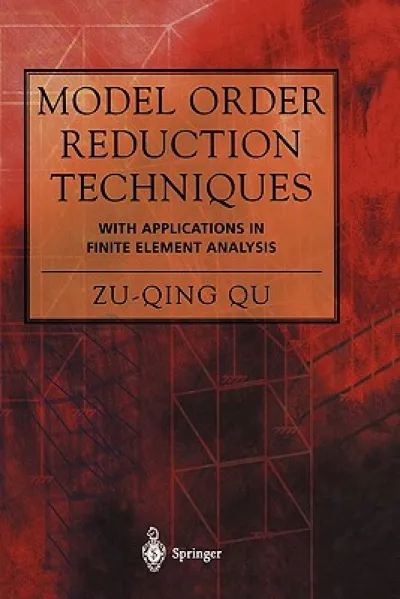
Model Order Reduction Techniques with Applications in Finite Element Analysis
Click to zoom

Share this book

Model Order Reduction Techniques with Applications in Finite Element Analysis

Softcover reprint of hardcover 1st ed. 2004

Book Details

Format Paperback / Softback
ISBN-10 1849969248
ISBN-13 9781849969246
Edition Softcover reprint of hardcover 1st ed. 2004
Publisher Springer London Ltd
Imprint Springer London Ltd
Country of Manufacture GB
Country of Publication GB
Publication Date Oct 13th, 2010
Print length 369 Pages
Ksh 17,800.00
Werezi Extended Catalogue 0 in stock

Delivery Location

Delivery fee: Select location

Secure
Quality
Fast
Despite the continued rapid advance in computing speed and memory the increase in the complexity of models used by engineers persists in outpacing them. Even where there is access to the latest hardware, simulations are often extremely computationally intensive and time-consuming when full-blown models are under consideration. The need to reduce the computational cost involved when dealing with high-order/many-degree-of-freedom models can be offset by adroit computation. In this light, model-reduction methods have become a major goal of simulation and modeling research. Model reduction can also ameliorate problems in the correlation of widely used finite-element analyses and test analysis models produced by excessive system complexity. Model Order Reduction Techniques explains and compares such methods focusing mainly on recent work in dynamic condensation techniques:- Compares the effectiveness of static, exact, dynamic, SEREP and iterative-dynamic condensation techniques in producing valid reduced-order models;- Shows how frequency shifting and the number of degrees of freedom affect the desirability and accuracy of using dynamic condensation;- Answers the challenges involved in dealing with undamped and non-classically damped models;- Requires little more than first-engineering-degree mathematics and highlights important points with instructive examples. Academics working in research on structural dynamics, MEMS, vibration, finite elements and other computational methods in mechanical, aerospace and structural engineering will find Model Order Reduction Techniques of great interest while it is also an excellent resource for researchers working on commercial finite-element-related software such as ANSYS and Nastran.

Despite the continued rapid advance in computing speed and memory the increase in the complexity of models used by engineers persists in outpacing them. Even where there is access to the latest hardware, simulations are often extremely computationally intensive and time-consuming when full-blown models are under consideration.

The need to reduce the computational cost involved when dealing with high-order/many-degree-of-freedom models can be offset by adroit computation. In this light, model-reduction methods have become a major goal of simulation and modeling research. Model reduction can also ameliorate problems in the correlation of widely used finite-element analyses and test analysis models produced by excessive system complexity.

Model Order Reduction Techniques explains and compares such methods focusing mainly on recent work in dynamic condensation techniques:

- Compares the effectiveness of static, exact, dynamic, SEREP and iterative-dynamic condensation techniques in producing valid reduced-order models;

- Shows how frequency shifting and the number of degrees of freedom affect the desirability and accuracy of using dynamic condensation;

- Answers the challenges involved in dealing with undamped and non-classically damped models;

- Requires little more than first-engineering-degree mathematics and highlights important points with instructive examples.

Academics working in research on structural dynamics, MEMS, vibration, finite elements and other computational methods in mechanical, aerospace and structural engineering will find Model Order Reduction Techniques of great interest while it is also an excellent resource for researchers working on commercial finite-element-related software such as ANSYS and Nastran.


Get Model Order Reduction Techniques with Applications in Finite Element Analysis by at the best price and quality guaranteed only at Werezi Africa's largest book ecommerce store. The book was published by Springer London Ltd and it has pages.


Mind, Body, & Spirit

Shopping Cart

Africa largest book store

Sub Total:
Ebooks

Digital Library
Coming Soon

Our digital collection is currently being curated to ensure the best possible reading experience on Werezi. We'll be launching our Ebooks platform shortly.