
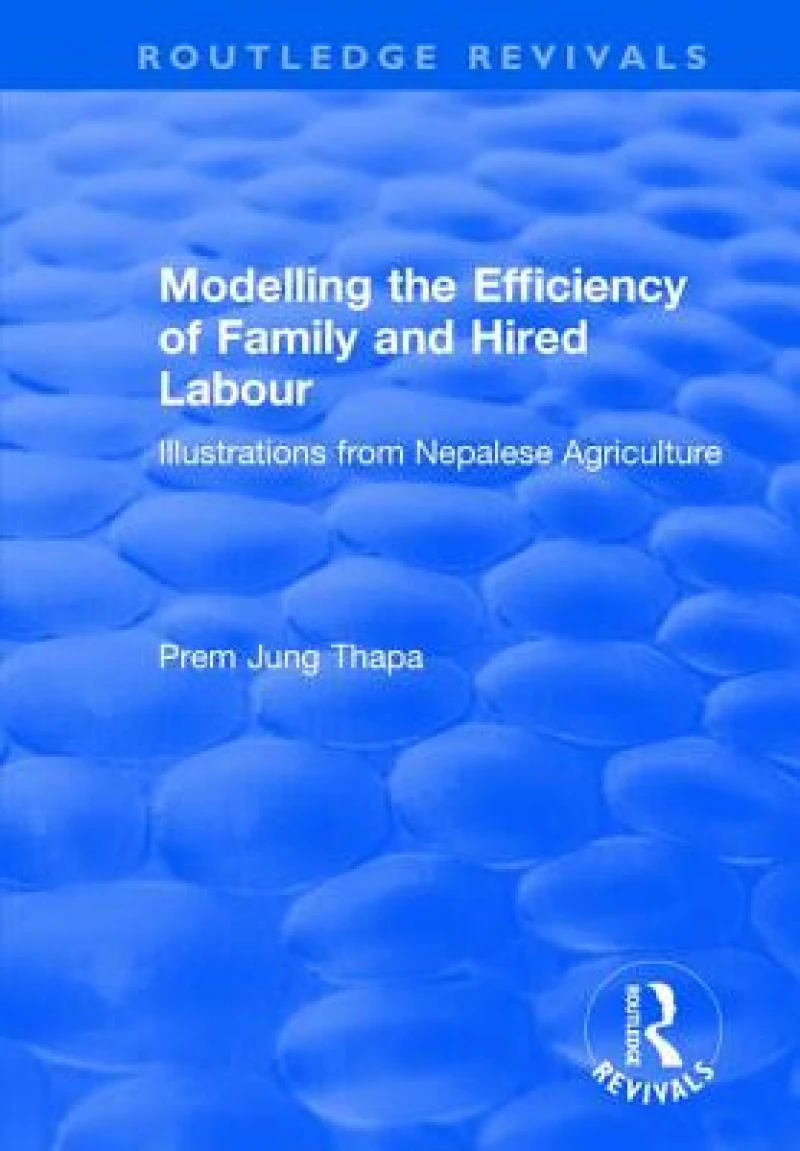
Modelling the Efficiency of Family and Hired Labour : Illustrations from Nepalese Agriculture
Book Details
Format
Paperback / Softback
Book Series
Routledge Revivals
ISBN-10
1138712183
ISBN-13
9781138712188
Publisher
Taylor & Francis Ltd
Imprint
Routledge
Country of Manufacture
GB
Country of Publication
GB
Publication Date
Oct 29th, 2019
Print length
236 Pages
Weight
336 grams
Dimensions
15.10 x 21.90 x 2.10 cms
Ksh 6,500.00
Werezi Extended Catalogue
0 in stock
Delivery Location
Delivery fee: Select location
Secure
Quality
Fast
This title was first published in 2003.The principal economic units in most developing countries are family based farm households. Empirical models that recognize the dual role of the farm household as producer and consumer in a theoretically consistent manner are essential tools for policy analyses. This book provides an important extension of the conventional farm household model by developing an analytical framework that allows for efficiency differences between family and hired labour as inputs in farm production. The model is estimated with survey data from the southern lowland region of Nepal. The estimation strategy is a two-step process. The first step estimates a farm-level production function in which is embedded a test for heterogeneity between family and hired labour. The labour heterogeneity detected in the production function estimation is incorporated, at the second step, in the labour supply estimation in a theoretically consistent manner. The methodological novelty is to relate the shadow wage rate for family labour to the observed market wage rate for hired labour, adjusted for the differential productivity of family and hired labour detected in the production function estimation.
Get Modelling the Efficiency of Family and Hired Labour by at the best price and quality guaranteed only at Werezi Africa's largest book ecommerce store. The book was published by Taylor & Francis Ltd and it has pages.

