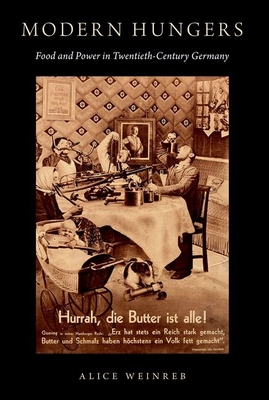
Modern Hungers : Food and Power in Twentieth-Century Germany
Book Details
Format
Hardback
ISBN-10
019060509X
ISBN-13
9780190605094
Publisher
Oxford University Press Inc
Imprint
Oxford University Press Inc
Country of Manufacture
US
Country of Publication
GB
Publication Date
Jun 15th, 2017
Print length
328 Pages
Weight
614 grams
Dimensions
16.50 x 24.30 x 2.80 cms
Product Classification:
European history20th century history: c 1900 to c 2000Economic historyFood security & supply
KSh 15,300.00
Currently unavailable
0 in stock
Delivery Location
Delivery fee: Select location
Secure
Quality
Fast
Spanning World War I to the fall of the Berlin Wall, Modern Hungers shows how food and hunger have been central to economic policy, political identity, and everyday life in modern Germany. It historicizes contemporary issues ranging from the obesity epidemic to the gender-wage gap to famine relief.
During the first decades of the twentieth century, modern states fighting World War I and II for the first time experimented with feeding--and starving--entire populations. Within the new globalizing economy, food became intimately intertwined with waging war. In Europe, starvation claimed more lives than any other weapon of war. As Alice Weinreb shows in Modern Hungers, nowhere was this more apparent than in Germany, initiator and loser of both wars. The end of armed conflict in 1945 did not mean that such military strategies declined in significance. Fears of hunger and fantasies of abundance were instead reframed within a new political system that saw the world as divided between capitalism and communism. Divided Germany rapidly became the key European stage for the Cold War. During the postwar decades, Europeans lived longer, possessed more goods, and were healthier than ever before. Nothing signaled this shift more clearly than the disappearance of famine from the continent. So powerful was the experience of post-1945 abundance that it is hard today to imagine a time when the specter of hunger haunted Europe, demographers feared that malnutrition would mean the end of whole nations, and the primary targets for American food aid was Belgium and Germany rather than Africa. Yet under both capitalist and communist systems, economic growth and political priorities proved inseparable from the modern food system. Drawing on sources ranging from military records to cookbooks to economic and nutritional studies from East and West German archives, Modern Hungers reveals similarities and striking ruptures in popular experience and state policy relating to the industrial food economy. It thus offers historical context for many key contemporary concerns ranging from humanitarian food aid to the gender-wage gap to the obesity epidemic.
Get Modern Hungers by Alice Weinreb at the best price and quality guaranteed only at Werezi Africa's largest book ecommerce store. The book was published by Oxford University Press Inc and it has 328 pages.
Customers Who Bought This Also Bought

Age of Revolutions
KSh 2,350.00

Eichmann in Jerusalem
KSh 2,350.00

Trouble With Being Born
KSh 2,000.00

Hiroshima
KSh 2,000.00

Freedom
KSh 6,300.00
Holocaust
KSh 2,700.00
The History of the Peloponnesian War
KSh 2,700.00
Annals
KSh 2,350.00

Greek Lives
KSh 2,150.00
Sleepwalkers
KSh 3,400.00

Napoleon The Great
KSh 3,600.00
Diary of a Young Girl
KSh 1,800.00