
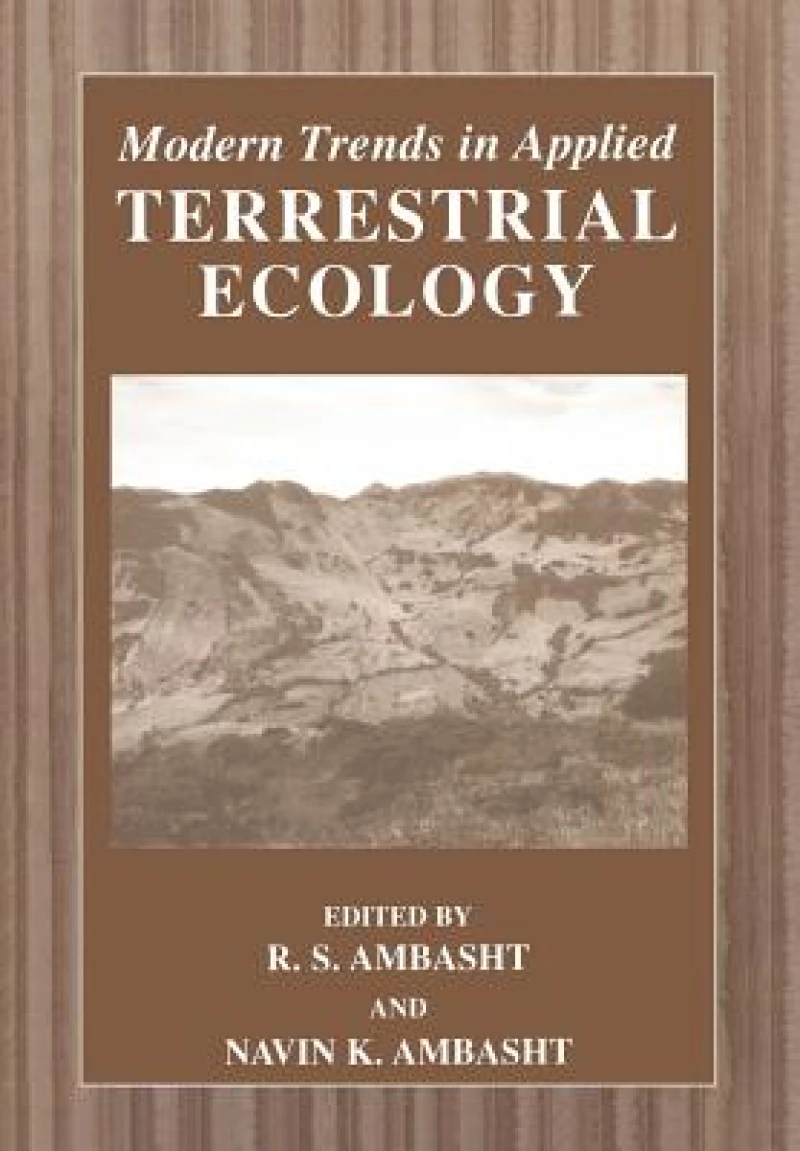
Modern Trends in Applied Terrestrial Ecology
Softcover reprint of the original 1st ed. 2002
Book Details
Format
Paperback / Softback
ISBN-10
1461349737
ISBN-13
9781461349730
Edition
Softcover reprint of the original 1st ed. 2002
Publisher
Springer-Verlag New York Inc.
Imprint
Springer-Verlag New York Inc.
Country of Manufacture
US
Country of Publication
GB
Publication Date
Oct 3rd, 2012
Print length
367 Pages
Ksh 23,400.00
Werezi Extended Catalogue
0 in stock
Delivery Location
Delivery fee: Select location
Secure
Quality
Fast
Ecology and economics have Greek roots in oikos for "household", logos for "study", and nomics for "management". Thus, ecology and economics should have complemented one another for a proper growth and development without destruction, but, unfortunately, rapid industrialization, lure for fast financial gains, and commercialization activities have led to a widespread surge in pollution load, environmental degradation, habitat destruction, rapid loss ofbiodiversity, sudden rise in rate ofextinction ofmany wildlife and wild relatives of domesticated animals and cultivated cereals and other plants, global climate changes creating global rise in temperature, and CO levels and increased ultraviolet B at ground 2 level. Although these threats to human health have led us to look to ecology for their solutions and guidance for sustainable development without destruction, the industrial and technology houses are looking for alternative methods of development and resource use methods. The two global conferences of the United Nations in 1972 and 1992, and international programs of Man and the Biosphere (MAB), International Biological Program (IBP), International Geosphere, Biosphere program (lGBP), and World Conser vation Union (IUCN), of different commissions, United Nations Environmental Program (UNEP) efforts, Ramsar Conventions (for wetlands), and World Wide fund for Nature (WWF) (for nature in general and wildlife in particular) have focused attention of ecologists, naturalists, governments and Non-governmental organizations (NGOs) toward better conservation.
Ecology and economics have Greek roots in oikos for "household", logos for "study", and nomics for "management". Thus, ecology and economics should have complemented one another for a proper growth and development without destruction, but, unfortunately, rapid industrialization, lure for fast financial gains, and commercialization activities have led to a widespread surge in pollution load, environmental degradation, habitat destruction, rapid loss ofbiodiversity, sudden rise in rate ofextinction ofmany wildlife and wild relatives of domesticated animals and cultivated cereals and other plants, global climate changes creating global rise in temperature, and CO levels and increased ultraviolet B at ground 2 level. Although these threats to human health have led us to look to ecology for their solutions and guidance for sustainable development without destruction, the industrial and technology houses are looking for alternative methods of development and resource use methods. The two global conferences of the United Nations in 1972 and 1992, and international programs of Man and the Biosphere (MAB), International Biological Program (IBP), International Geosphere, Biosphere program (lGBP), and World Conser vation Union (IUCN), of different commissions, United Nations Environmental Program (UNEP) efforts, Ramsar Conventions (for wetlands), and World Wide fund for Nature (WWF) (for nature in general and wildlife in particular) have focused attention of ecologists, naturalists, governments and Non-governmental organizations (NGOs) toward better conservation.
Get Modern Trends in Applied Terrestrial Ecology by at the best price and quality guaranteed only at Werezi Africa's largest book ecommerce store. The book was published by Springer-Verlag New York Inc. and it has pages.

