
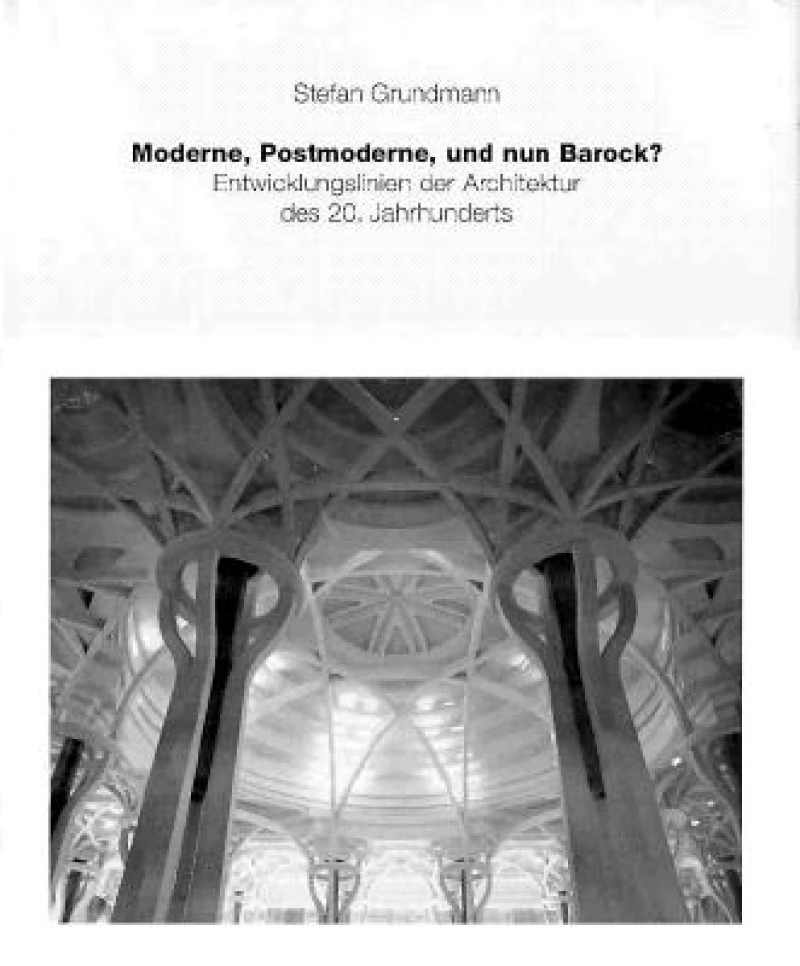
Moderne, Postmoderne und nun Barock? : Entwick- lungslinien der Architektur des 20. Jahrhunderts
Book Details
Format
Hardback or Cased Book
ISBN-10
3930698633
ISBN-13
9783930698639
Publisher
Edition Axel Menges
Imprint
Edition Axel Menges
Country of Manufacture
DE
Country of Publication
GB
Publication Date
Jan 1st, 1995
Print length
136 Pages
Weight
1,038 grams
Dimensions
29.40 x 24.00 x 2.00 cms
Product Classification:
Architecture
Ksh 5,850.00
Werezi Extended Catalogue
0 in stock
Delivery Location
Delivery fee: Select location
Secure
Quality
Fast
Discusses the development of modern architecture in the context of architectural history.
"This book is an attempt at architectural criticism" that is how Robert Venturi opened the discussion on Post-Modernism in architecture in Complexity and Contradiction in Architecturea generation ago. And this was a typical beginning. Criticism of the Modern movement by architects like Le Corbusier Mies van der Rohe and to extent Frank Lloyd Wright as well that had preceded it was central to Post-Modernism. Soon the architectural historians joined in with the architects, particularly Charles Jencks in the English-speaking world and Heinrich Klotz in Germany. Here too Post-Modern-ism was the start, with three fundamental critical points about Modernism: fundamental emptiness of its architecture, its lack of relation to its surroundings and its overemphasis of functionalism against decoration. And so, even if one does not use pamphlets like Tom Wolfe''s or Jencks'' early work as a yardstick, the image of the buildings by what are still the best-known architects of our century is strongly overshadowed. The truth is that the International Style reflects the basic forces that architecture can express extraordinarily impressively and al-ways with decided interplay, and thus also with a pronounced unity of effect; and additionally it develops these formal values especially intensively from content. Traditionally such things are called classical. What followed this, the whole spectrum of styles from late Modernism via High-Tech and Deconstructivism to Post-Modernism is all a reaction to the unity of the International Style: either one point in terms of form or content is taken out, exaggerated and thus made into its opposite, or such a point is consciously negated. Until now this phenomenon has been known as Mannerism to art historians. What is characteristic of Baroque as the period after High Renaissance Classicism and Mannerism is less clear; in any case, entirely positive aspects of both found their way into Baroque, and undoubtedly the latter is closer to High Re-naissance Classicism in spirit than to Mannerism. Cannot similar things be seen in the last bare decade of architectural develop-ment? The foundations for this book were laid during a good year''s re-search at the University of California in Berkeley. The author now holds a chair at the Martin-Luther-Universität Halle-Wittenberg.
Discusses the development of modern architecture in the context of architectural history.
Get Moderne, Postmoderne und nun Barock? by at the best price and quality guaranteed only at Werezi Africa's largest book ecommerce store. The book was published by Edition Axel Menges and it has pages.

