
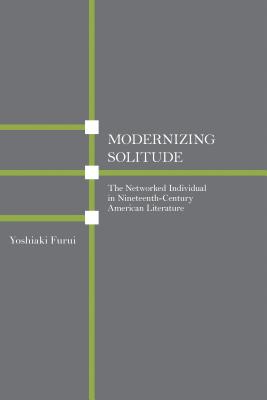
Modernizing Solitude : The Networked Individual in Nineteenth-Century American Literature
Book Details
Format
Hardback
ISBN-10
0817320067
ISBN-13
9780817320065
Publisher
The University of Alabama Press
Imprint
The University of Alabama Press
Country of Manufacture
US
Country of Publication
GB
Publication Date
Feb 5th, 2019
Print length
232 Pages
Weight
558 grams
Dimensions
23.70 x 16.20 x 2.40 cms
Product Classification:
Literary studies: general
KSh 8,100.00
Temporarily out of stock, due soon
0 in stock
Delivery Location
Delivery fee: Select location
Secure
Quality
Fast
An innovative and timely examination of the concept of solitude in nineteenth-century American literature. Though solitude, and the lack thereof, is a pressing concern in today's culture of omnipresent digital connectivity, Yoshiaki Furui shows that solitude has been a significant preoccupation since the nineteenth-century.
An innovative and timely examination of the concept of solitude in nineteenth-century American literature.
During the nineteenth century, the United States saw radical developments in media and communication that reshaped concepts of spatiality and temporality. As the telegraph, the postal system, and public transportation became commonplace, the country achieved a level of connectedness that was never possible before. At this level, physical isolation no longer equaled psychological separation from the exterior world, and as communication networks proliferated, being disconnected took on negative cultural connotations.
Though solitude, and the lack thereof, is a pressing concern in today''s culture of omnipresent digital connectivity, Yoshiaki Furui shows that solitude has been a significant preoccupation since the nineteenth-century. The obsession over solitude is evidenced by many writers of the period, with consequences for many basic notions of creativity, art, and personal and spiritual fulfillment.
In Modernizing Solitude: The Networked Individual in Nineteenth-Century American Literature, Furui examines, among other works, Henry David Thoreau''s Walden, Harriet Jacobs''s Incidents in the Life of a Slave Girl, Herman Melville''s “Bartleby, the Scrivener,” Emily Dickinson''s poetry and letters, and telegraphic literature in the 1870s to identify the virtues and values these writers bestowed upon solitude in a time and place where it was being consistently threatened or devalued. Although each writer has a unique way of addressing the theme, they all aim to reclaim solitude as a positive, productive state of being that is essential to the writing process and personal identity. Employing a cross-disciplinary approach to understand modern solitude and the resulting literature, Furui seeks to historicize solitude by anchoring literary works in this revolutionary yet interim period of American communication history, while also applying theoretical insights into the literary analysis.
During the nineteenth century, the United States saw radical developments in media and communication that reshaped concepts of spatiality and temporality. As the telegraph, the postal system, and public transportation became commonplace, the country achieved a level of connectedness that was never possible before. At this level, physical isolation no longer equaled psychological separation from the exterior world, and as communication networks proliferated, being disconnected took on negative cultural connotations.
Though solitude, and the lack thereof, is a pressing concern in today''s culture of omnipresent digital connectivity, Yoshiaki Furui shows that solitude has been a significant preoccupation since the nineteenth-century. The obsession over solitude is evidenced by many writers of the period, with consequences for many basic notions of creativity, art, and personal and spiritual fulfillment.
In Modernizing Solitude: The Networked Individual in Nineteenth-Century American Literature, Furui examines, among other works, Henry David Thoreau''s Walden, Harriet Jacobs''s Incidents in the Life of a Slave Girl, Herman Melville''s “Bartleby, the Scrivener,” Emily Dickinson''s poetry and letters, and telegraphic literature in the 1870s to identify the virtues and values these writers bestowed upon solitude in a time and place where it was being consistently threatened or devalued. Although each writer has a unique way of addressing the theme, they all aim to reclaim solitude as a positive, productive state of being that is essential to the writing process and personal identity. Employing a cross-disciplinary approach to understand modern solitude and the resulting literature, Furui seeks to historicize solitude by anchoring literary works in this revolutionary yet interim period of American communication history, while also applying theoretical insights into the literary analysis.
Get Modernizing Solitude by Yoshiaki Furui at the best price and quality guaranteed only at Werezi Africa's largest book ecommerce store. The book was published by The University of Alabama Press and it has 232 pages.
Customers Who Bought This Also Bought

How to Read a Book
KSh 2,000.00

Decolonising the Mind
KSh 4,700.00

How to Read & Why
KSh 2,350.00

Arabian Nights'' Entertainments
KSh 2,950.00

In the Wake
KSh 3,600.00
The Birth of Tragedy
KSh 1,800.00

Against Nature
KSh 1,800.00

The White Album
KSh 3,250.00
Robinson Crusoe
KSh 1,450.00

Metaphysical Poetry
KSh 2,350.00

Reading Lessons
KSh 2,350.00

Literature Book
KSh 4,250.00
