
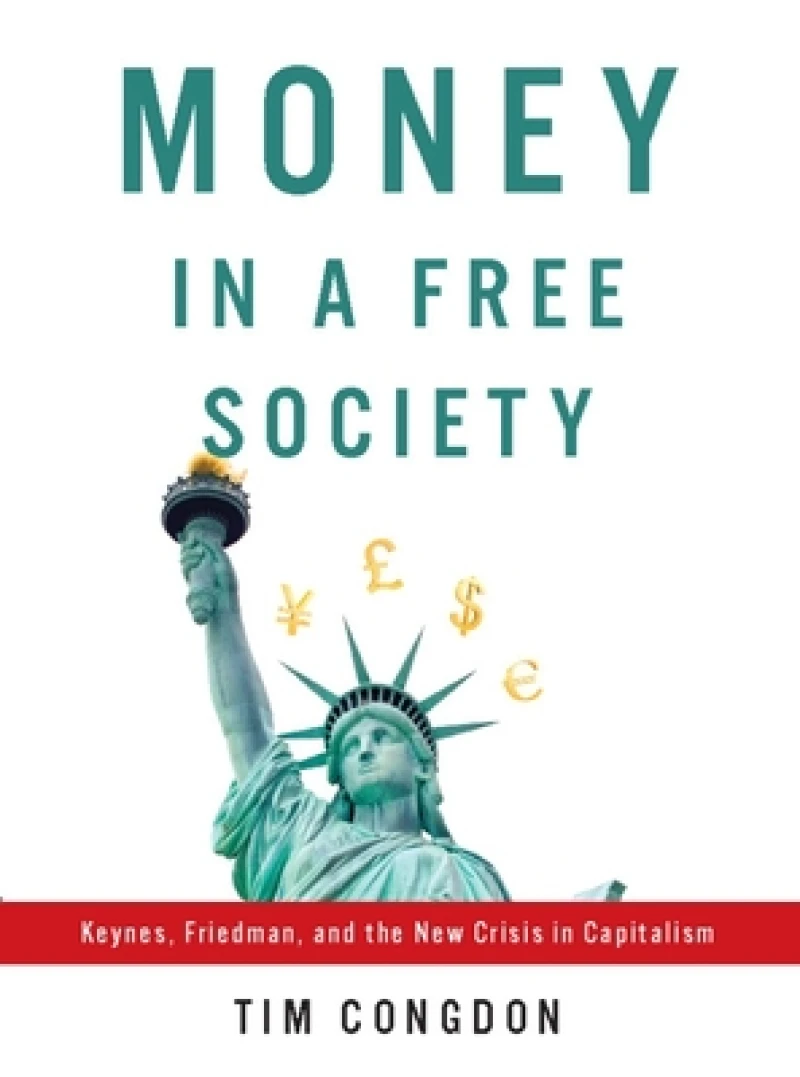
Money in a Free Society : Keynes, Friedman, and the New Crisis in Capitalism
by
Tim Congdon
Book Details
Format
Hardback or Cased Book
ISBN-10
1594035245
ISBN-13
9781594035241
Publisher
Encounter Books,USA
Imprint
Encounter Books,USA
Country of Manufacture
GB
Country of Publication
GB
Publication Date
Dec 15th, 2011
Print length
486 Pages
Weight
850 grams
Product Classification:
Macroeconomics
Ksh 4,250.00
Re-Printing
0 in stock
Delivery Location
Delivery fee: Select location
Secure
Quality
Fast
In the 15 years to mid-2007 the world economy enjoyed unparalleled stability (the so-called "Great Moderation"), with steady growth and low inflation. But the period since mid-2007 ("the Great Recession") has seen the worst macroeconomic turmoil since the 1930s. A dramatic plunge in trade, output and employment in late 2008 and 2009 has been followed by an unconvincing recovery. How is the lurch from stability to instability to be explained? What are the intellectual origins of the policy mistakes that led to the Great Recession? What theories motivated policies in the USA and other leading nations? Which ideas about economic policy have proved right? And which have been wrong? Money in a Free Society contains 18 provocative essays on these questions from Tim Congdon, an influential economic adviser to the Thatcher government in the UK and one of the world's leading monetary commentators. Congdon argues that academic economists and policy-makers have betrayed the intellectual legacy of both Keynes and Friedman. These two great economists believed -- if in somewhat different ways -- in the need for steady growth in the quantity of money. But Keynes has been misunderstood as advocating big rises in public spending and large budget deficits as the only way to defeat recession. That has led under President Obama to an unsustainable explosion in American public debt. Meanwhile the Fed has ignored extreme volatility in the rate of money growth, contrary to the central message of Friedman's analytical work. In his 1923 Tract on Monetary Reform Keynes said, "The Individualistic Capitalism of today, precisely because it entrusts saving to the individual investor and production to the individual employer, presumes a stable measuring-rod of value, and cannot be efficient--perhaps cannot survive--without one." In Money in a Free Society Congdon calls for a return to stable money growth and sound public finances, and argues that these remain the best answers to the problems facing modern capitalism.
In the 15 years to mid-2007 the world economy enjoyed unparalleled stability (the so-called “Great Moderation”), with steady growth and low inflation. But the period since mid-2007 (“the Great Recession”) has seen the worst macroeconomic turmoil since the 1930s. A dramatic plunge in trade, output and employment in late 2008 and 2009 has been followed by an unconvincing recovery. How is the lurch from stability to instability to be explained? What are the intellectual origins of the policy mistakes that led to the Great Recession? What theories motivated policies in the USA and other leading nations? Which ideas about economic policy have proved right? And which have been wrong?
Money in a Free Society contains 18 provocative essays on these questions from Tim Congdon, an influential economic adviser to the Thatcher government in the UK and one of the world’s leading monetary commentators. Congdon argues that academic economists and policy-makers have betrayed the intellectual legacy of both Keynes and Friedman.
These two great economists believed – if in somewhat different ways – in the need for steady growth in the quantity of money. But Keynes has been misunderstood as advocating big rises in public spending and large budget deficits as the only way to defeat recession. That has led under President Obama to an unsustainable explosion in American public debt. Meanwhile the Fed has ignored extreme volatility in the rate of money growth, contrary to the central message of Friedman’s analytical work. In his 1923 Tract on Monetary Reform Keynes said, “The Individualistic Capitalism of today, precisely because it entrusts saving to the individual investor and production to the individual employer, presumes a stable measuring-rod of value, and cannot be efficient--perhaps cannot survive--without one.” In Money in a Free Society Congdon calls for a return to stable money growth and sound public finances, and argues that these remain the best answers to the problems facing modern capitalism.
Money in a Free Society contains 18 provocative essays on these questions from Tim Congdon, an influential economic adviser to the Thatcher government in the UK and one of the world’s leading monetary commentators. Congdon argues that academic economists and policy-makers have betrayed the intellectual legacy of both Keynes and Friedman.
These two great economists believed – if in somewhat different ways – in the need for steady growth in the quantity of money. But Keynes has been misunderstood as advocating big rises in public spending and large budget deficits as the only way to defeat recession. That has led under President Obama to an unsustainable explosion in American public debt. Meanwhile the Fed has ignored extreme volatility in the rate of money growth, contrary to the central message of Friedman’s analytical work. In his 1923 Tract on Monetary Reform Keynes said, “The Individualistic Capitalism of today, precisely because it entrusts saving to the individual investor and production to the individual employer, presumes a stable measuring-rod of value, and cannot be efficient--perhaps cannot survive--without one.” In Money in a Free Society Congdon calls for a return to stable money growth and sound public finances, and argues that these remain the best answers to the problems facing modern capitalism.
Get Money in a Free Society by at the best price and quality guaranteed only at Werezi Africa's largest book ecommerce store. The book was published by Encounter Books,USA and it has pages.

