
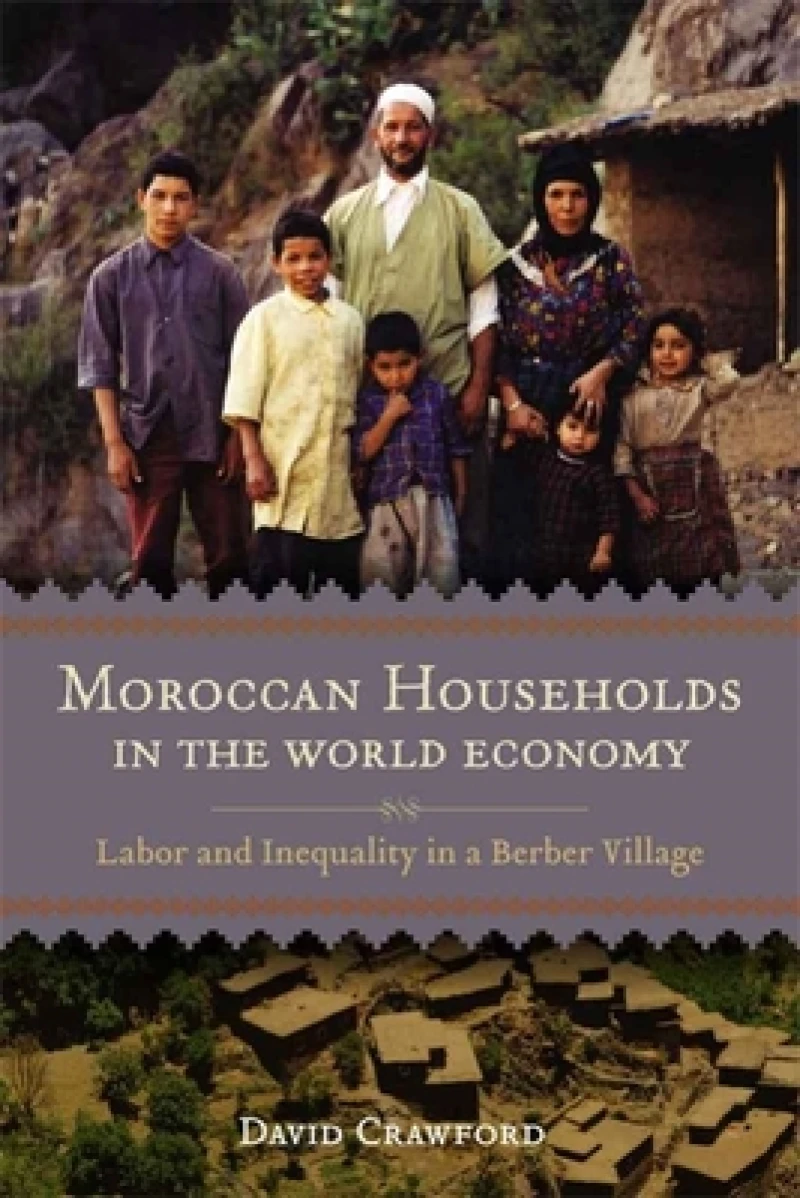
Moroccan Households in the World Economy : Labor and Inequality in a Berber Village
Book Details
Format
Paperback / Softback
ISBN-10
0807133728
ISBN-13
9780807133729
Publisher
Louisiana State University Press
Imprint
Louisiana State University Press
Country of Manufacture
US
Country of Publication
GB
Publication Date
Nov 15th, 2008
Print length
232 Pages
Weight
350 grams
Dimensions
15.30 x 22.80 x 1.60 cms
Product Classification:
Anthropology
Ksh 4,650.00
Werezi Extended Catalogue
0 in stock
Delivery Location
Delivery fee: Select location
Secure
Quality
Fast
Provides a detailed study of the rhythms of highland Berber life, from the daily routines of making a living in such a demanding environment to the relationships between individuals, the community, and the national economy.
In the High Atlas Mountains of Morocco, far from the hustle and noise of urban centers, lies a village made of mud and rock, barely discernible from the surrounding landscape. Yet a closer look reveals a carefully planned community of homes nestled above the trees, where rock slides are least frequent, and steep terraces of barley fields situated just above spring flood level. The Berber-speaking Muslims who live and farm on these precipitous mountainsides work together at the arduous task of irrigating the fields during the dry season, continuing a long tradition of managing land, labor, and other essential resources collectively. In Moroccan Households in the World Economy, David Crawford provides a detailed study of the rhythms of highland Berber life, from the daily routines of making a living in such a demanding environment to the relationships between individuals, the community, and the national economy.
Demonstrating a remarkably complete understanding of every household and person in the village, Crawford traces the intricacies of cooperation between households over time. Employing a calculus known as ""arranging the bones,"" villagers attempt to balance inequality over the long term by accounting for fluctuations in the needs and capacities of each person, household, and family at different stages in its history. Tradition dictates that children ""owe"" labor to their parents and grandparents as long as they live, and fathers decide when and where the children in their household work. Some may be asked to work for distant religious lodges or urban relatives they haven't met because of a promise made by long-dead ancestors. Others must migrate to cities to work as wage laborers and send their earnings home to support their rural households.
While men and women leave their community to work, Morocco and the wider world come to the village in the form of administrators, development agents, and those representing commercial interests, all with their own agendas and senses of time. Integrating a classic village-level study that nevertheless engages with the realities of contemporary migration, Crawford succinctly summarizes common perceptions and misperceptions about the community while providing a salient critique of the global expansion of capital.
In this beautifully observed ethnography, Crawford challenges assumptions about how Western economic processes transfer to other contexts and pulls the reader into an exotic world of smoke-filled kitchens, dirt-floored rooms, and communal rooftop meals -- a world every bit as fascinating as it is instructive.
Demonstrating a remarkably complete understanding of every household and person in the village, Crawford traces the intricacies of cooperation between households over time. Employing a calculus known as ""arranging the bones,"" villagers attempt to balance inequality over the long term by accounting for fluctuations in the needs and capacities of each person, household, and family at different stages in its history. Tradition dictates that children ""owe"" labor to their parents and grandparents as long as they live, and fathers decide when and where the children in their household work. Some may be asked to work for distant religious lodges or urban relatives they haven't met because of a promise made by long-dead ancestors. Others must migrate to cities to work as wage laborers and send their earnings home to support their rural households.
While men and women leave their community to work, Morocco and the wider world come to the village in the form of administrators, development agents, and those representing commercial interests, all with their own agendas and senses of time. Integrating a classic village-level study that nevertheless engages with the realities of contemporary migration, Crawford succinctly summarizes common perceptions and misperceptions about the community while providing a salient critique of the global expansion of capital.
In this beautifully observed ethnography, Crawford challenges assumptions about how Western economic processes transfer to other contexts and pulls the reader into an exotic world of smoke-filled kitchens, dirt-floored rooms, and communal rooftop meals -- a world every bit as fascinating as it is instructive.
Get Moroccan Households in the World Economy by at the best price and quality guaranteed only at Werezi Africa's largest book ecommerce store. The book was published by Louisiana State University Press and it has pages.

