
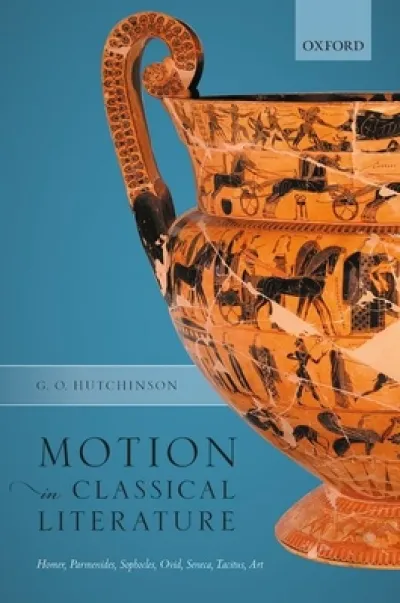
Motion in Classical Literature : Homer, Parmenides, Sophocles, Ovid, Seneca, Tacitus, Art
Book Details
Format
Hardback or Cased Book
ISBN-10
0198855621
ISBN-13
9780198855620
Publisher
Oxford University Press
Imprint
Oxford University Press
Country of Manufacture
GB
Country of Publication
GB
Publication Date
May 7th, 2020
Print length
328 Pages
Weight
664 grams
Dimensions
24.20 x 16.50 x 2.40 cms
Product Classification:
Ancient WorldLatinAncient (Classical) GreekClassical styleHistory of art: ancient & classical art,BCE to c 500 CEHistory of artLiterary studies: ancient, classical and medievalLiterary studies: classical, early & medievalClassical Greek & Roman archaeologyArchaeology by period / region
Ksh 21,900.00
Werezi Extended Catalogue
0 in stock
Delivery Location
Delivery fee: Select location
Secure
Quality
Fast
Classical literature is full of humans, gods, and animals in impressive motion, though motion has yet to receive significant attention in scholarship and criticism. The case-studies in this volume explore how motion is treated in Greek and Latin visual art and literature, offering a new and stimulating approach to these well-known works.
Classical literature is full of humans, gods, and animals in impressive motion. The specific features of this motion are expressive; it is closely intertwined with decisions, emotions, and character. However, although the importance of space has recently been realized with the advent of the ''spatial turn'' in the humanities, motion has yet to receive such attention, for all its prominence in literature and its interest to ancient philosophy. This volume begins with an exploration of motion in particular works of visual art, and continues by examining the characteristics of literary depiction. Seven works are then used as case-studies: Homer''s Iliad, Ovid''s Metamorphoses, Tacitus'' Annals, Sophocles'' Philoctetes and Oedipus at Colonus, Parmenides'' On Nature, and Seneca''s Natural Questions. The two narrative poems diverge rewardingly, as do the philosophical poetry and prose. Important in the philosophical poem and the prose history are metaphorical motion and the absence of motion; the dramas scrutinize motion verbally and visually. Each study first pursues the general roles of motion in the particular work and provides detail on its language of motion. It then engages in close analysis of particular passages, to show how much emerges when motion is scrutinized. Among the aspects which emerge as important are speed, scale, and shape of movement; motion and fixity; the movement of one person and a group; motion willed and imposed; motion in images and in unrealized possibilities. The conclusion looks at these aspects across the works, and at differences of genre and period. This new and stimulating approach opens up extensive areas for interpretation; it can also be productively applied to the literature of successive eras.
Get Motion in Classical Literature by at the best price and quality guaranteed only at Werezi Africa's largest book ecommerce store. The book was published by Oxford University Press and it has pages.

