
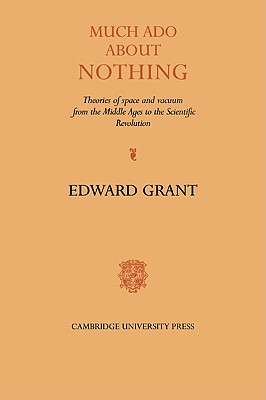
Much ADO about Nothing : Theories of Space and Vacuum from the Middle Ages to the Scientific Revolution
Book Details
Format
Paperback / softback
ISBN-10
052106192X
ISBN-13
9780521061926
Publisher
Cambridge University Press
Imprint
Cambridge University Press
Country of Manufacture
GB
Country of Publication
GB
Publication Date
May 15th, 2008
Print length
472 Pages
Weight
686 grams
Dimensions
23.40 x 15.70 x 2.50 cms
Product Classification:
History of scienceRelativity physics
KSh 6,650.00
Currently unavailable
0 in stock
Delivery Location
Delivery fee: Select location
Secure
Quality
Fast
The primary objective of this study is to provide a description of the major ideas about void space within and beyond the world that were formulated between the fourteenth and early eighteenth centuries. The second part of the book - on infinite, extracosmic void space - is of special significance.
The primary objective of this study is to provide a description of the major ideas about void space within and beyond the world that were formulated between the fourteenth and early eighteenth centuries. The second part of the book - on infinite, extracosmic void space - is of special significance. The significance of Professor Grant's account is twofold: it provides a comprehensive and detailed description of the scholastic Aristotelian arguments for and against the existence of void space; and it presents (again for the first time) an analysis of the possible influence of scholastic ideas and arguments on the interpretations of space proposed by the nonscholastic authors who made the Scientific Revolution possible. The concluding chapter of the book is unique in not only describing the conceptualizations of space proposed by the makers of the Scientific Revolution, but in assessing the role of readily available scholastic ideas on the conception of space adopted for the Newtonian world.
Get Much ADO about Nothing by Edward Grant at the best price and quality guaranteed only at Werezi Africa's largest book ecommerce store. The book was published by Cambridge University Press and it has 472 pages.
Customers Who Bought This Also Bought

Anaximander
KSh 2,000.00

When Breath Becomes Air
KSh 1,800.00
On the Origin of Species
KSh 1,600.00

Origin of Species
KSh 1,850.00
There Are Places in the World Where Rules Are Less Important Than Kindness
KSh 2,350.00
Every Living Thing
KSh 2,350.00

Everything Is Tuberculosis
KSh 3,950.00
Short History of Nearly Everything 2.0
KSh 3,550.00

Short History of Nearly Everything
KSh 2,350.00

Classics Origin of Species
KSh 1,100.00

Essential Galileo
KSh 2,900.00
Helgoland
KSh 2,350.00
