
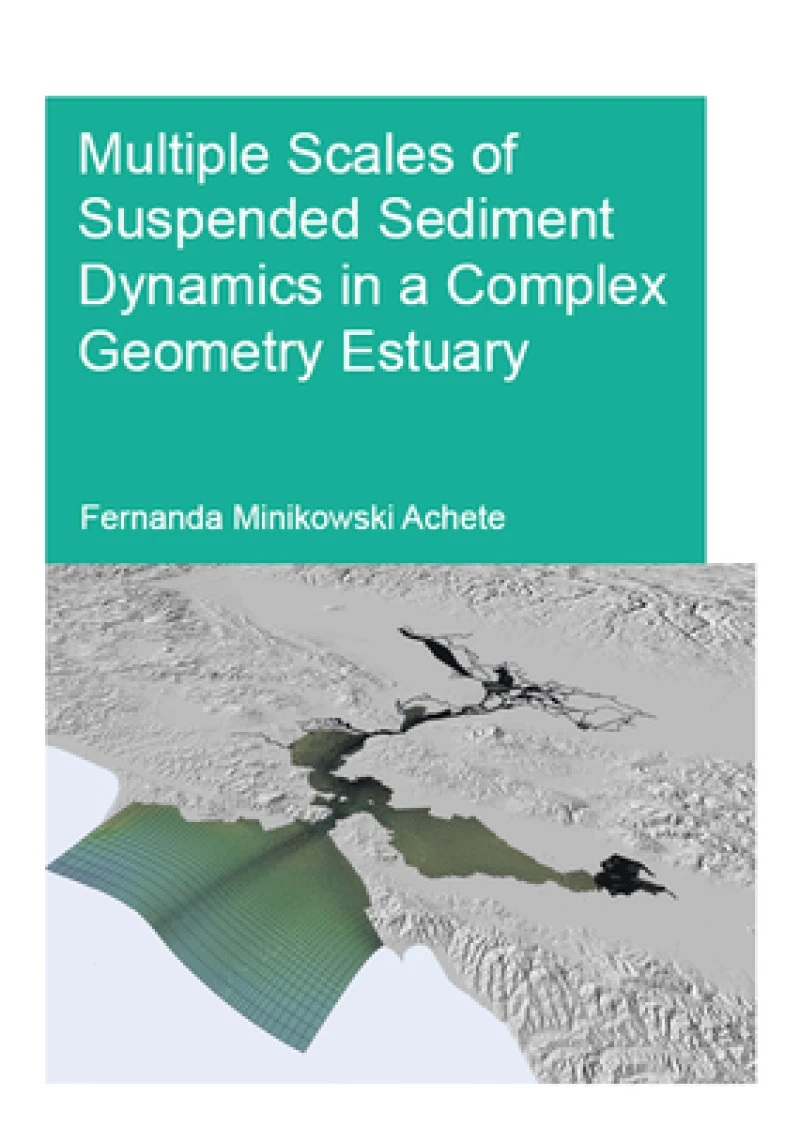
Multiple Scales of Suspended Sediment Dynamics in a Complex Geometry Estuary
Book Details
Delivery Location
Delivery fee: Select location
This study contributes to investigate and forecast turbidity levels and sediment budget variability at San Francisco Bay-Delta system at a variety of spatial and temporal scales applying a flexible mesh process-based model (Delft3D FM). It is possible to have a robust sediment model, which reproduces 90% of the yearly data derived sediment budget, with simple model settings, such as applying one mud fraction and a simple bottom sediment distribution. This finding opens opportunities for modeling less monitored estuaries.
Comparing the Sacramento-San Joaquin Delta and the Alviso Slough, a classification for estuaries regarding the main sediment dynamic forcing is proposed: event-driven estuary (Delta) and tide-driven estuary (Alviso Slough). In the event-driven estuaries, the rivers are the main sediment source and the tides have minor impact in the net sediment transport. In the tide-driven estuaries, the main sediment source is the bottom sediment and the tide asymmetry defines the net sediment transport.
Many estuaries are located in urbanized, highly engineered environments. Cohesive sediment plays an important role due to its link with estuarine health and ecology. An important ecological parameter is the suspended sediment concentration (SSC) translated into turbidity levels and sediment budget.
This study contributes to investigate and forecast turbidity levels and sediment budget variability at San Francisco Bay-Delta system at a variety of spatial and temporal scales applying a flexible mesh process-based model (Delft3D FM). It is possible to have a robust sediment model, which reproduces 90% of the yearly data derived sediment budget, with simple model settings, like applying one mud fraction and a simple bottom sediment distribution. This finding opens the horizon for modeling less monitored estuaries.
Comparing two case studies, i.e. the Sacramento-San Joaquin Delta and Alviso Slough, a classification for estuaries regarding the main sediment dynamic forcing is proposed: event-driven estuary (Delta) and tide-driven estuary (Alviso Slough). In the event-driven estuaries, the rivers are the main sediment source and the tides have minor impact in the net sediment transport. In the tide-driven estuaries, the main sediment source is the bottom sediment and the tide asymmetry defines the net sediment transport.
This research also makes advances in connecting different scientific fields and developing a managerial tool to support decision making. It provides the basis to a chain of models, which goes from the hydrodynamics, to suspended sediment, to phytoplankton, to fish, clams and marshes.
Get Multiple Scales of Suspended Sediment Dynamics in a Complex Geometry Estuary by at the best price and quality guaranteed only at Werezi Africa's largest book ecommerce store. The book was published by Taylor & Francis Ltd and it has pages.

