
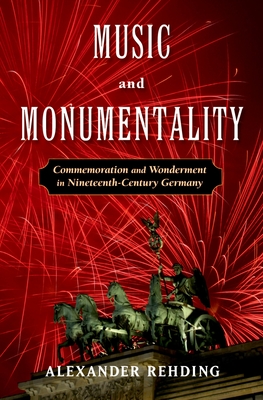
Music and Monumentality : Commemoration and Wonderment in Nineteenth Century Germany
Book Details
Format
Hardback
ISBN-10
0195385381
ISBN-13
9780195385380
Publisher
Oxford University Press Inc
Imprint
Oxford University Press Inc
Country of Manufacture
GB
Country of Publication
GB
Publication Date
Aug 20th, 2009
Print length
320 Pages
Weight
584 grams
Dimensions
23.50 x 16.50 x 3.00 cms
KSh 15,250.00
Temporarily out of stock, due soon
0 in stock
Delivery Location
Delivery fee: Select location
Secure
Quality
Fast
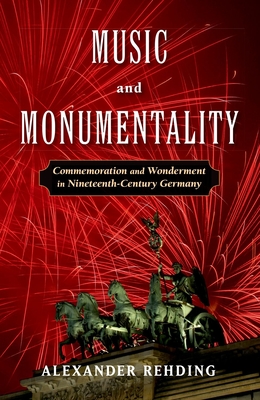
This critical study locates musical monumentality, a central property of the nineteenth-century German repertoire, at the intersections of aesthetics and memory. In examples including Beethoven, Liszt, Wagner and Bruckner, Rehding explores how monumentality contributes to an experiential music history and how it conveys the sublime to the listening public.
A few weeks after the reunification of Germany, Leonard Bernstein raised his baton above the ruins of the Berlin Wall and conducted a special arrangement of Beethoven''s Ninth Symphony. The central statement of the work, that "all men will be brothers," captured the sentiment of those who saw a brighter future for the newly reunited nation. This now-iconic performance is a palpable example of "musical monumentality" - a significant concept which underlies our cultural and ideological understanding of Western art music since the nineteenth-century. Although the concept was first raised in the earliest years of musicological study in the 1930s, a satisfying exploration of the "monumental" in music has not yet been made. Alexander Rehding, one of the brightest young stars in the field, takes on the task in Resounding Monumentality, an elegant, thorough treatment that will serve as a foundation for all future discussion in this area. Rehding sets his focus on the main players of the period within the Austro-German repertoire -Beethoven, Liszt, Wagner, Brahms, Bruckner and Mahler- as he unpacks a two-fold definition of "musical monumentality." In the conventional sense, monumentality is a stylistic property often described as ''grand,'' ''uplifting,'' and ''sublime'' and rife with overpowering brass chorales, sparkling string tremolos, triumphant fanfares, and glorious thematic returns. Yet Rehding sees the monumental in music performing a cultural task as well: it is employed in the service of establishing national identity. Through a clear theoretical lens, Rehding examines how grand sound effects are strategically employed with the view to overwhelming audiences, how supposedly immutable musical halls of fame change over time, how challenging musical works are domesticated, how the highest cultural achievements are presented in immediately consumable form-in a word, how German music emerges as a unified cultural and musical brand.
Get Music and Monumentality by Alexander Rehding at the best price and quality guaranteed only at Werezi Africa's largest book ecommerce store. The book was published by Oxford University Press Inc and it has 320 pages.
Customers Who Bought This Also Bought

Mark Kermode''s Surround Sound
KSh 3,400.00
Harmony and Theory
KSh 4,850.00

Fundamentals of Musical Composition
KSh 3,050.00
Music Theory: the essential guide
KSh 1,450.00

How Music Works
KSh 3,700.00
Essential Dictionary of Music Notation
KSh 1,950.00

Structural Functions of Harmony
KSh 2,700.00
Quantum Listening
KSh 1,450.00

The Technique of Orchestration
KSh 14,250.00
The Shortest History of Music
KSh 2,700.00

On The Musically Beautiful
KSh 3,250.00
The Study of Counterpoint
KSh 2,900.00
More by Alexander Rehding
Alien Listening – Voyager's Golden Record and Music from Earth
KSh 5,750.00
Hugo Riemann and the Birth of Modern Musical Thought
KSh 6,150.00
Music and Monumentality
KSh 7,450.00
The Oxford Handbook of Timbre
KSh 29,450.00
Hugo Riemann and the Birth of Modern Musical Thought
KSh 17,100.00
Beethoven's Symphony No. 9
KSh 18,300.00
Beethoven''s Symphony No. 9
KSh 3,550.00
