
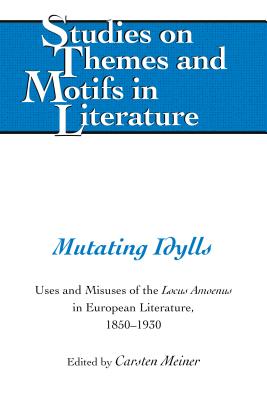
Mutating Idylls : Uses and Misuses of the Locus Amoenus in European Literature, 1850–1930
New
Book Details
Delivery Location
Delivery fee: Select location
Mutating Idylls examines the surprising presence of the antique literary topos of the idyllic landscape, the locus amoenus, in European literature from the latter half of the nineteenth century. The book sets out to identify how this topos, which generally has no place in politically and socially realistic and naturalist literature, actually does have a role to play. Chapters on central nineteenth-century authors such as Flaubert, Zola, Fontane, Verga, Hamsun, Austen, Eliot, Wilde, Jiménez, Cernuda, and Galdós demonstrate both the presence and the multiple refunctionalizations of the locus amoenus. The theoretical aim of Mutating Idylls is to rehabilitate the notion of literary topos. This feature is present in the introduction as a possibility in literary studies today. The chapters all argue in the direction of a notion of topos, which is more flexible than the one Curtius defines along the lines of formula or cliché. In this way, the book intervenes in at least three major fields of study: nineteenth-century studies, classical philology, and literary theory. Through empirical analyses covering diverse authors who all, more or less unconsciously, use the locus amoenus, Mutating Idylls offers a new understanding of the culture of writing in the nineteenth century and contributes to literary theory a rehabilitation of the important notion of the topos.
Get Mutating Idylls by Carsten Meiner at the best price and quality guaranteed only at Werezi Africa's largest book ecommerce store. The book was published by Peter Lang Publishing Inc and it has 242 pages.
Customers Who Bought This Also Bought
Dubliners
KSh 1,600.00
A Grammar of Mangghuer
KSh 10,050.00
Grammar of Mangghuer
KSh 30,950.00

Truth or Dare
KSh 2,350.00

You'll Never Know . . . If You Don't Try!
KSh 1,750.00

Innovations in Architecture, Design, Business, Society, Language and Literature
KSh 30,950.00

Innovations in Architecture, Design, Business, Society, Language and Literature
KSh 9,350.00

Mirza Ghalib’s Metaphors of Mortality
KSh 17,700.00

Innovations in Architecture, Design, Business, Society, Language and Literature
KSh 42,300.00
Cohesion in English
KSh 33,850.00

Decolonising Digital Media and Indigenisation of Participatory Epistemologies
KSh 8,650.00
A Description of Moldavia
KSh 6,650.00
