

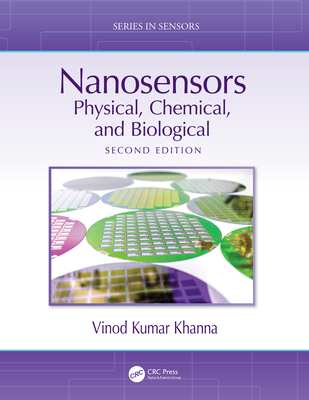
Nanosensors : Physical, Chemical, and Biological
Book Details
Format
Hardback
Book Series
Series in Sensors
ISBN-10
1041314035
ISBN-13
9781041314035
Publisher
Taylor & Francis Ltd
Imprint
CRC Press
Country of Manufacture
GB
Country of Publication
GB
Publication Date
Nov 24th, 2026
Print length
624 Pages
KSh 42,300.00
Not Yet Published
0 in stock
Delivery Location
Delivery fee: Select location
Secure
Quality
Fast
The book examines how nanoscale engineering improves sensitivity, specificity, and response time.
Nanosensors are innovative devices that exploit the unique properties exhibited by matter at the nanoscale. A growing and exciting field, nanosensors have spurred considerable research worldwide, driving the development of new device concepts and the engineering of nanostructured materials with controlled properties. Nanosensors: Physical, Chemical, and Biological, Third Edition offers a panoramic view of the field and related nanotechnologies with extraordinary clarity and depth. Presenting an interdisciplinary approach that blends physics, chemistry, and biology, this new edition is broad in scope and organized into seven parts, beginning with the fundamentals before moving on to nanomaterials and nanofabrication technologies in the second part. The third and fourth parts provide a critical appraisal of physical nanosensors and explore the chemical and biological categories of nanosensors. The fifth part sheds light on the emerging applications of nanosensors across society, industry, and defense, and details the cutting-edge applications of state-of-the-art nanosensors in environmental science, food technology, medical diagnostics, and biotechnology. The sixth part addresses self-powering and networking issues of nanosensors. The newly added seventh part addresses intelligent nanosensors and current research trends, describing machine learning techniques and AI-enhanced nanosensors. The third edition has been updated to reflect recent advancements in nanosensors that integrate nanotechnology and artificial intelligence. This is an ideal reference for researchers and industry professionals working at the forefront of materials science and semiconductor fabrication, as well as for graduate students in physics and engineering pursuing electrical engineering and electronics courses with a focus on nanoscience and nanotechnology. Key features:Provides an updated, all-encompassing exploration of contemporary nanosensors and highlights the exclusive nanoscale properties on which nanosensors are designed. Presents an accessible approach with a question-and-answer format to allow an easy grasp of the intricacies involved in the complex working mechanisms of devices. Contains clear, illustrative diagrams that enable visualization of nanosensor operations, along with worked examples, end-of-chapter questions, and exhaustive, up-to-date bibliographies appended to each chapter.
Get Nanosensors by Vinod Kumar Khanna at the best price and quality guaranteed only at Werezi Africa's largest book ecommerce store. The book was published by Taylor & Francis Ltd and it has 624 pages.
Customers Who Bought This Also Bought

Early Earthquakes of the Americas
KSh 21,600.00

The Physics of Medical Imaging
KSh 37,800.00

Nuclear Power Plants
KSh 23,400.00

Introduction to Particle Therapy
KSh 12,250.00

Covid-19
KSh 19,800.00

Radiation Protection Dosimetry
KSh 15,100.00

Environmentally Benign Photocatalysts
KSh 18,000.00

Polymer Composites and Nanocomposites for X-Rays Shielding
KSh 8,100.00

Inspection of Medical Devices
KSh 16,200.00

Medical Physics
KSh 8,200.00

Tools and Techniques in Radiation Biophysics
KSh 13,500.00

Bayesian Inference
KSh 18,000.00
More by Vinod Kumar Khanna
Implantable Medical Electronics
KSh 23,400.00

2D Materials-Based Sensors
KSh 10,800.00

Beyond Complementary Metal-Oxide-Semiconductor Nanoelectronics
KSh 26,300.00
Implantable Medical Electronics
KSh 23,400.00

Introduction to Machine Learning Algorithms
KSh 30,950.00

IoT Sensors
KSh 10,300.00

AI Robotics
KSh 26,300.00

Fundamentals of Solid-State Lighting
KSh 37,800.00
Nanosensors
KSh 52,200.00

Nano-Structured Photovoltaics
KSh 26,300.00

Flexible Electronics, Volume 2
KSh 17,800.00

IoT Sensors
KSh 26,300.00
