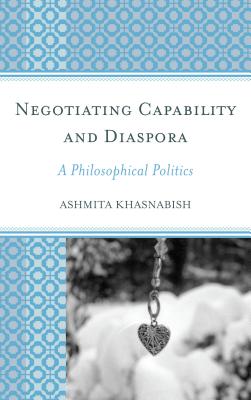
Negotiating Capability and Diaspora : A Philosophical Politics
Book Details
Format
Paperback / softback
ISBN-10
1498532306
ISBN-13
9781498532303
Publisher
Bloomsbury Publishing Plc
Imprint
Lexington Books
Country of Manufacture
US
Country of Publication
GB
Publication Date
Dec 15th, 2015
Print length
182 Pages
Weight
268 grams
Dimensions
15.30 x 22.70 x 1.60 cms
Product Classification:
Social & political philosophyPolitical economySocial and political philosophy
KSh 9,700.00
Currently unavailable
0 in stock
Delivery Location
Delivery fee: Select location
Secure
Quality
Fast
Negotiating Capability and Diaspora: A Philosophical Politics scrutinizes Indian economist cum philosopher Amartya Sen’s theory of capability, which rose as a critique of the modern American philosopher John Rawls’s theory of primary goods. Ashmita Khasnabish develops Sen’s theory of capability as a leitmotif throughout the book. She focuses on the following themes: 1) how Amartya Sen’s theory of capability offers strength to immigrants and underdogs; 2) the significance of John Rawls’s theory for Sen’s theory of capability; 3) two aspects of Sen’s theory: on the one hand it exposes the asymmetry between people of power and the powerless due to the discrepancy of resources, and on the other hand it shows how the powerless or the underdogs or the minorities could exert their will-power through the paradigm of choices to overcome; 4) finally, Sri Aurobindo’s theory of democracy, which intersects with John Rawls’s theory of comprehensive doctrines and political justice. Khasnabish also discusses authors Amitav Ghosh, Jhumpa Lahiri, and Toni Morrison, whose novels illustrate different facets of the theory of capability.
Negotiating Capability and Diaspora develops themes that will be of great interest to students and scholars of political philosophy, feminist philosophy, postcolonial studies, literary studies, Diaspora studies, and world literature.
Negotiating Capability and Diaspora develops themes that will be of great interest to students and scholars of political philosophy, feminist philosophy, postcolonial studies, literary studies, Diaspora studies, and world literature.
Get Negotiating Capability and Diaspora by Ashmita Khasnabish at the best price and quality guaranteed only at Werezi Africa's largest book ecommerce store. The book was published by Bloomsbury Publishing Plc and it has 182 pages.
Customers Who Bought This Also Bought

End of History and the Last Man
KSh 2,700.00

12 Rules for Life
KSh 2,350.00

The 48 Laws of Power
KSh 4,700.00

Second Treatise of Government – Norton Library
KSh 1,600.00

Discipline and Punish
KSh 2,350.00

The Prince The Original Classic
KSh 2,150.00

How to Be a Leader – An Ancient Guide to Wise Leadership
KSh 2,800.00

The Origin of Others
KSh 3,600.00

Outlines of the Philosophy of Right
KSh 2,500.00

How Fascism Works
KSh 2,900.00

The Prince
KSh 1,800.00

Who''s Afraid of Gender?
KSh 2,350.00