
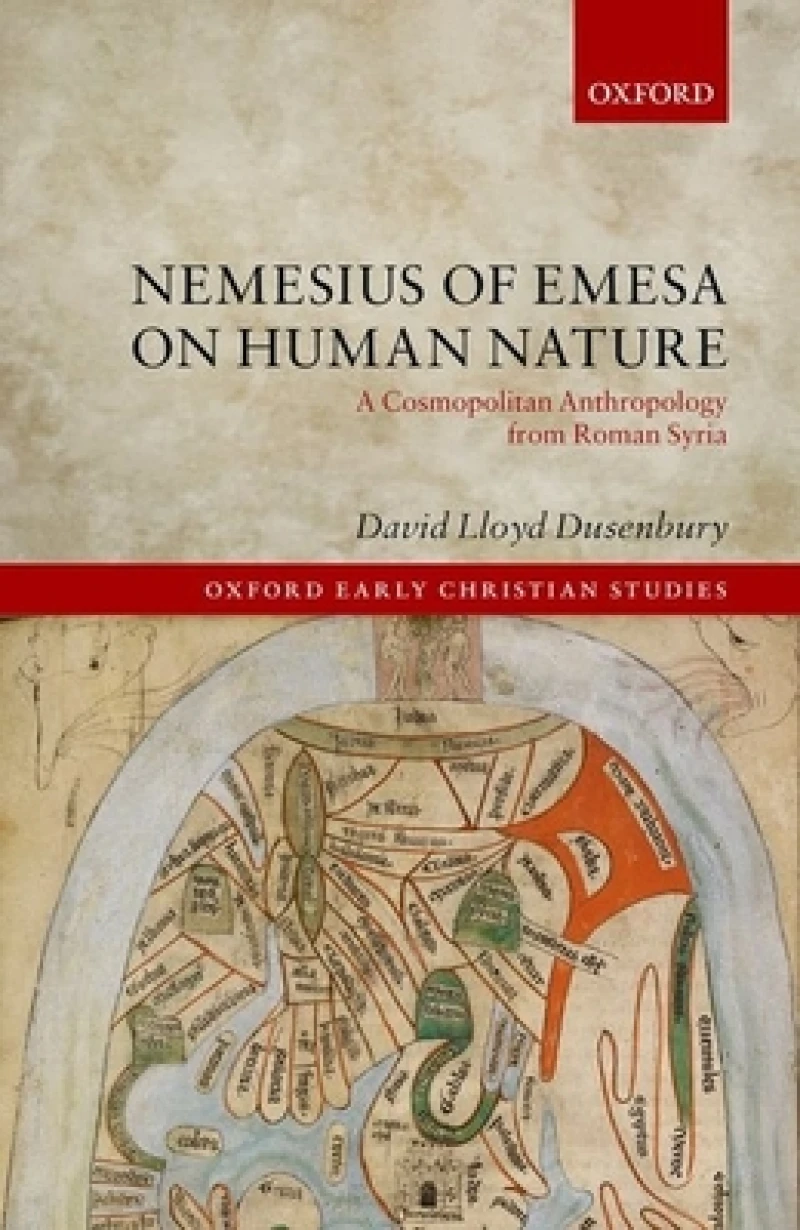
Nemesius of Emesa on Human Nature : A Cosmopolitan Anthropology from Roman Syria
Book Details
Format
Hardback or Cased Book
Book Series
Oxford Early Christian Studies
ISBN-10
0198856962
ISBN-13
9780198856962
Publisher
Oxford University Press
Imprint
Oxford University Press
Country of Manufacture
GB
Country of Publication
GB
Publication Date
Aug 20th, 2021
Print length
230 Pages
Weight
392 grams
Dimensions
24.30 x 15.80 x 2.30 cms
Product Classification:
Western philosophy: Ancient, to c 500History of religionChristianityAnthropology
Ksh 17,900.00
Manufactured on Demand
0 in stock
Delivery Location
Delivery fee: Select location
Secure
Quality
Fast
David Lloyd Dusenbury provides the first monograph in English on the first Christian anthropology--a text which influenced ideas about human nature in the Byzantine and Islamicate worlds, and in Europe, well into the early modern period.
Nemesius of Emesa''s On Human Nature (De Natura Hominis) is the first Christian anthropology. Written in Greek, circa 390 CE, it was read in half a dozen languages--from Baghdad to Oxford--well into the early modern period. Nemesius'' text circulated in two Latin versions in the centuries that saw the rise of European universities, shaping scholastic theories of human nature. During the Renaissance there were numerous print editions helping to inspire a new discourse of human dignity. David Lloyd Dusenbury offers the first monograph in English on Nemesius'' treatise. In the interpretation offered here, the Syrian bishop seeks to define the human qua human. His early Christian anthropology is cosmopolitan. He writes, ''Things that are natural are the same for all.'' In his pages, a host of texts and discourses--biblical and medical, legal and philosophical--are made to converge upon a decisive tenet of Christian late antiquity: humans'' natural freedom. For Nemesius, reason and choice are a divine double-strand of powers. Since he believes that both are a natural human inheritance, he concludes that much is ''in our power''. Nemesius defines humans as the only living beings who are at once ruler (intellect) and ruled (body). Because of this, the human is a ''little world'', binding the rationality of angels to the flux of elements, the tranquillity of plants, and the impulsiveness of animals. This compelling study traces Nemesius'' reasoning through the whole of On Human Nature, as he seeks to give a long-influential image of humankind both philosophical and anatomical proof.
Get Nemesius of Emesa on Human Nature by at the best price and quality guaranteed only at Werezi Africa's largest book ecommerce store. The book was published by Oxford University Press and it has pages.

