
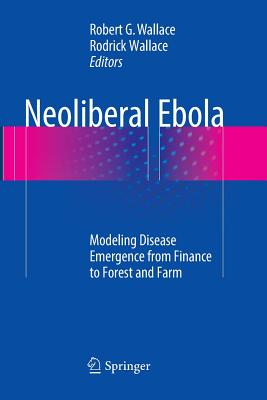
Neoliberal Ebola : Modeling Disease Emergence from Finance to Forest and Farm
Softcover reprint of the original 1st ed. 2016
Book Details
Format
Paperback / softback
ISBN-10
3319822233
ISBN-13
9783319822235
Edition
Softcover reprint of the original 1st ed. 2016
Publisher
Springer International Publishing AG
Imprint
Springer International Publishing AG
Country of Manufacture
GB
Country of Publication
GB
Publication Date
Jun 12th, 2018
Print length
96 Pages
KSh 8,100.00
Currently unavailable
0 in stock
Delivery Location
Delivery fee: Select location
Secure
Quality
Fast
This volume compiles five papers modeling the effects of neoliberal economics on the emergence of Ebola and its aftermath. Neoliberalism is currently the world''s primary economic philosophy. It centers international relations around globalizing laissez-faire economics for multinational companies, promoting free trade, deregulating economic markets, and shifting state expenditures in favor of private property. The multidisciplinary teams represented here place both Ebola Makona, the Zaire Ebola virus variant that has infected 28,000 in West Africa, and Ebola Reston, which is currently emerging in industrial hog farms in the Philippines and China, within a multi-plank modeling framework. Using a stochastic extinction model that one group spatializes, environmental stochasticity across the ecologies in which Ebola evolves is treated as an ecosystemic prophylaxis. An agroecological logic gate is developed for epidemic control. A Black-Scholes model explicitly links economic margins across agricultural systems to success in biocontrol. This new control theory is further developed around the data-rate and rate-distortion theorems, a turbulence model, and cognitive symmetry breaking. Lastly, a model of pandemic penetrance is used to explore the domino effects of serious outbreaks amplifying through the cascades of disasters that can follow deadly pandemics. All the models presented are contextualized by socioeonomic geographies specific to outbreak locales.
Together the models suggest shifts in regional agroeconomics under the neoliberal doctrine, driving deforestation and monoculture production, destroying the ecosystemic "friction" with which local forests typically disrupt Ebola transmission. The resulting collapse in such an ecological function accelerates pathogen spillover and propagation across the remaining host populations. The failure on the part of current control efforts to assimilate such a structural context may render even an efficacious vaccine dysfunctional. The authors propose an alternate science of disease and an adjunct program of interventions useful to researchers and public health officials alike.
Get Neoliberal Ebola by Robert G. Wallace at the best price and quality guaranteed only at Werezi Africa's largest book ecommerce store. The book was published by Springer International Publishing AG and it has 96 pages.
Customers Who Bought This Also Bought

Computational Design of Chemicals for the Control of Mosquitoes and Their Diseases
KSh 9,700.00

Key Issues in Childhood and Youth Studies
KSh 8,000.00

Key Issues in Childhood and Youth Studies
KSh 30,950.00

Integrating Clinical Research into Epidemic Response
KSh 10,800.00

Anal Fissure
KSh 10,450.00

Health Promotion
KSh 37,800.00

Automating Health
KSh 9,700.00

McGavock's How Drugs Work
KSh 36,000.00

Clinical Scenarios in Oral and Maxillofacial Diseases
KSh 11,350.00

Poison Powder
KSh 6,650.00

Delivering Health Care in America: a Systems Approach
KSh 14,850.00

Imagining Illness – Public Health and Visual Culture
KSh 3,900.00
More in This Genre
Computational Design of Chemicals for the Control of Mosquitoes and Their Diseases
KSh 9,700.00
Key Issues in Childhood and Youth Studies
KSh 8,000.00
Key Issues in Childhood and Youth Studies
KSh 30,950.00
Integrating Clinical Research into Epidemic Response
KSh 10,800.00
Anal Fissure
KSh 10,450.00
Health Promotion
KSh 37,800.00
