Book Details
Delivery Location
Delivery fee: Select location
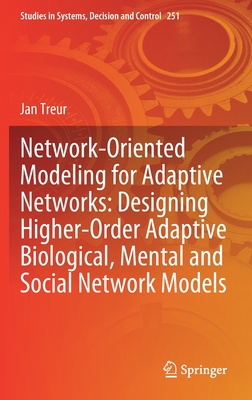
This book addresses the challenging topic of modeling adaptive networks, which often manifest inherently complex behavior. Networks by themselves can usually be modeled using a neat, declarative, and conceptually transparent Network-Oriented Modeling approach. In contrast, adaptive networks are networks that change their structure; for example, connections in Mental Networks usually change due to learning, while connections in Social Networks change due to various social dynamics. For adaptive networks, separate procedural specifications are often added for the adaptation process. Accordingly, modelers have to deal with a less transparent, hybrid specification, part of which is often more at a programming level than at a modeling level.
This book presents an overall Network-Oriented Modeling approach that makes designing adaptive network models much easier, because the adaptation process, too, is modeled in a neat, declarative, and conceptually transparent Network-Oriented Modeling manner, like the network itself. Thanks to this approach, no procedural, algorithmic, or programming skills are needed to design complex adaptive network models. A dedicated software environment is available to run these adaptive network models from their high-level specifications.
Moreover, because adaptive networks are described in a network format as well, the approach can simply be applied iteratively, so that higher-order adaptive networks in which network adaptation itself is adaptive (second-order adaptation), too can be modeled just as easily. For example, this can be applied to model metaplasticity in cognitive neuroscience, or second-order adaptation in biological and social contexts. The book illustrates the usefulness of this approach via numerous examples of complex (higher-order) adaptive network models for a wide variety of biological, mental, and social processes.
The book is suitable for multidisciplinary Master''s and Ph.D. students without assuming much prior knowledge, although also some elementary mathematical analysis is involved. Given the detailed information provided, it can be used as an introduction to Network-Oriented Modeling for adaptive networks. The material is ideally suited for teaching undergraduate and graduate students with multidisciplinary backgrounds or interests. Lecturers will find additional material such as slides, assignments, and software.Get Network-Oriented Modeling for Adaptive Networks by Jan Treur at the best price and quality guaranteed only at Werezi Africa's largest book ecommerce store. The book was published by Springer Nature Switzerland AG and it has 412 pages.
Customers Who Bought This Also Bought

Thinking in Systems
KSh 3,050.00

For Everyone Bible Study Guide: Luke
KSh 1,250.00

The Laws of Thought
KSh 2,000.00

Laws of Thought
KSh 3,050.00

Laws of Thought
KSh 4,500.00

Frankenstein and STEAM – Essays for Charles E. Robinson
KSh 22,300.00

Algorithms in Advanced Artificial Intelligence
KSh 30,950.00

Algorithms in Advanced Artificial Intelligence
KSh 9,350.00

Linear Systems Theory
KSh 37,800.00

Fractals and Chaos
KSh 28,450.00

Theories and Models of Urbanization
KSh 26,800.00

Machine Intelligence and Data Analytics for Sustainable Future Smart Cities
KSh 27,000.00