
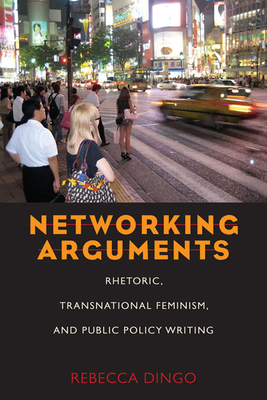
Networking Arguments : Rhetoric, Transnational Feminism, and Public Policy Writing
Book Details
Format
Paperback / softback
Book Series
Composition, Literacy, and Culture
ISBN-10
0822961881
ISBN-13
9780822961888
Publisher
University of Pittsburgh Press
Imprint
University of Pittsburgh Press
Country of Manufacture
US
Country of Publication
GB
Publication Date
Mar 30th, 2012
Print length
192 Pages
Product Classification:
Language: reference & generalLanguage: reference and general
KSh 7,350.00
Temporarily out of stock, due soon
0 in stock
Delivery Location
Delivery fee: Select location
Secure
Quality
Fast
An original study on the use and misuse of global institutional rhetoric and the effects of these practices on women, particularly in developing countries. Using a feminist lens, Rebecca Dingo views the complex networks that rhetoric flows through, globally and nationally, and how it’s often reconfigured to work both for and against women and to maintain existing power structures.
Networking Arguments presents an original study on the use and misuse of global institutional rhetoric and the effects of these practices on women, particularly in developing countries. Using a feminist lens, Rebecca Dingo views the complex networks that rhetoric flows through, globally and nationally, and how itÆs often reconfigured to work both for and against women and to maintain existing power structures. To see how rhetorics travel, Dingo deconstructs the central terminology employed by global institutions—mainstreaming, fitness, and empowerment—and shows how their meanings shift depending on the contexts in which theyÆre used. She studies programs by the World Bank, the United Nations, and the United States, among others, to view the original policies, then follows the trail of their diffusion and manipulation and the ultimate consequences for individuals. To analyze transnational rhetorical processes, Dingo builds a theoretical framework by employing concepts of transcoding, ideological traffic, and interarticulation to uncover the intricacies of power relationships at work within networks. She also views transnational capitalism, neoliberal economics, and neocolonial ideologies as primary determinants of policy and arguments over womenÆs roles in the global economy. Networking Arguments offers a new method of feminist rhetorical analysis that allows for an increased understanding of global gender policies and encourages strategies to counteract the negative effects they can create.
Get Networking Arguments by Rebecca Dingo at the best price and quality guaranteed only at Werezi Africa's largest book ecommerce store. The book was published by University of Pittsburgh Press and it has 192 pages.
Customers Who Bought This Also Bought
Dictionary of Linguistics and Phonetics, Seventh Edition
KSh 7,200.00

Biblical Names and Their Meanings
KSh 800.00

Thinking Through Translation
KSh 5,050.00

John Stuart Mill and the Writing of Character
KSh 6,400.00

Hunting Lieutenant Chadbourne
KSh 4,800.00

The Language of the American South
KSh 4,000.00

French as Language of Intimacy in the Modern Age
KSh 8,650.00

The Routledge Hispanic Studies Companion to Nineteenth-Century Latin America
KSh 10,250.00

Golosa
KSh 26,100.00

Malayalam
KSh 12,900.00

The Old English Version of the enlarged «Rule of Chrodegang»
KSh 16,550.00

Chinese Children''s Reading Acquisition
KSh 16,200.00
More by Rebecca Dingo


More in This Genre
Dictionary of Linguistics and Phonetics, Seventh Edition
KSh 7,200.00
Biblical Names and Their Meanings
KSh 800.00
Thinking Through Translation
KSh 5,050.00
John Stuart Mill and the Writing of Character
KSh 6,400.00
Hunting Lieutenant Chadbourne
KSh 4,800.00
The Language of the American South
KSh 4,000.00
