
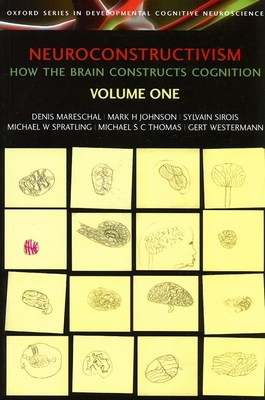
Neuroconstructivism - I : How the brain constructs cognition
Book Details
Format
Paperback / softback
Book Series
Developmental Cognitive Neuroscience
ISBN-10
0198529910
ISBN-13
9780198529910
Publisher
Oxford University Press
Imprint
Oxford University Press
Country of Manufacture
GB
Country of Publication
GB
Publication Date
Jan 18th, 2007
Print length
288 Pages
Weight
420 grams
Dimensions
23.70 x 15.60 x 1.60 cms
KSh 13,550.00
Currently unavailable
0 in stock
Delivery Location
Delivery fee: Select location
Secure
Quality
Fast
What are the processes, from conception to adulthood, that enable a single cell to grow into a sentient adult? Neuroconstructivism is a pioneering 2 volume work that sets out a whole new framework for considering the complex topic of development, integrating data from cognitive studies, computational work, and neuroimaging.
What are the processes, from conception to adulthood, that enable a single cell to grow into a sentient adult? The processes that occur along the way are so complex that any attempt to understand development necessitates a multi-disciplinary approach, integrating data from cognitive studies, computational work, and neuroimaging - an approach till now seldom taken in the study of child development.Neuroconstructivism is a major new 2 volume publication that seeks to redress this balance, presenting an integrative new framework for considering development. In the first volume, the authors review up-to-to date findings from neurobiology, brain imaging, child development, computer and robotic modelling to consider why children''s thinking develops the way it does. They propose a new synthesis of development that is based on 5 key principles found to operate at many levels of descriptions. They use these principles to explain what causes a number of key developmental phenomena, including infants'' interacting with objects, early social cognitive interactions, and the causes of dyslexia. The "neuroconstructivist" framework also shows how developmental disorders do not arise from selective damage to the normal cognitive system, but instead arise from developmental processes that operate under atypical constraints. How these principles work is illustrated in several case studies ranging from perceptual to social and reading development. Finally, the authors use neuroimaging, behavioural analyses, computational simulations and robotic models to provide a way of understanding the mechanisms and processes that cause development to occur.
Get Neuroconstructivism - I by Denis Mareschal, Gert Westermann at the best price and quality guaranteed only at Werezi Africa's largest book ecommerce store. The book was published by Oxford University Press and it has 288 pages.
Customers Who Bought This Also Bought

Xmeditations
KSh 700.00

Order of Time
KSh 2,350.00

Being and Nothingness
KSh 7,300.00

The Analects
KSh 2,350.00

The Life Of The Mind
KSh 3,950.00

The Kybalion - Hermetic Philosophy - Revised and Updated Edition
KSh 2,000.00

Xrepublic
KSh 850.00

Aristotle''s De Anima
KSh 3,550.00

Xrepublic
KSh 1,450.00

Sharing Thoughts
KSh 17,000.00

Vocation of Man
KSh 2,500.00

Treatise Concerning the Principles of Human Knowledge
KSh 2,000.00
More by Denis Mareschal, Gert Westermann

A-Z of Educational Neuroscience
KSh 4,700.00

A-Z of Educational Neuroscience
KSh 26,300.00

A Student''s Guide to Developmental Psychology
KSh 9,700.00

Neuroconstructivism - I
KSh 35,750.00

Neuroconstructivism - II
KSh 26,300.00

Educational Neuroscience
KSh 25,200.00

Thinking Developmentally from Constructivism to Neuroconstructivism
KSh 30,950.00

Neuroconstructivism - II
KSh 11,200.00

Thinking Developmentally from Constructivism to Neuroconstructivism
KSh 8,050.00

How the Brain Works
KSh 4,200.00

Educational Neuroscience
KSh 3,550.00

How the Brain Works
KSh 12,600.00
